
- Home
- Industries
Industries
Enabling transformation and progress across a wide range of industries globally, fostering innovation and growth in every sector.
Explore all → - Solutions
Connectivity
Connecting industries worldwide with reliable satellite internet solutions, driving innovation, efficiency, and growth across all sectors globally.
Explore all → - Services
Professional VSAT & IT Services
Delivering expert VSAT and IT solutions for seamless connectivity, reliability, and performance across all sectors.
Explore all → - Products
Superior Connectivity, Trusted Solutions
Offering premium Satcom products that guarantee reliable connectivity and boost innovation across industries.
Explore all → - Coverage
WorldWide Coverage
Delivering tailored satellite services that enhance connectivity, foster innovation, and support growth in every industry.
Explore all → - About
- Blog
- Contact
XMW M-TD3010 Ka Dual-Band 10W Mobility BUC
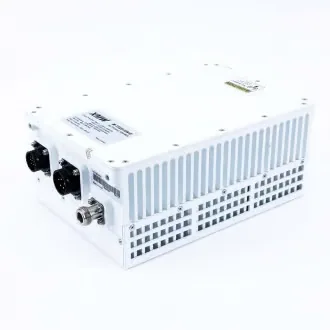
XMW M-TD3010 Ka Dual-Band 10W Mobility BUC
The XMW M-TD3010 is a Ka dual-band 10W BUC designed for mobility terminals that need to work across two Ka-band uplink segments. A 950 to 1950 MHz input per band feeds local oscillators at 28.05 GHz and 29.05 GHz, giving output coverage of 29.00 to 30.00 GHz and 30.00 to 31.00 GHz. The block upconverter is rated at 10 W, quoted as 38 dBm, with 71 dB of gain, a 15 dB adjustment range in 1 dB steps and phase noise of -73 dBc at 1 kHz. It runs from +48 VDC at 63 W.
Key Features
- Dual-band Ka coverage spanning 29.00 to 31.00 GHz from one unit
- 10 W, quoted as 38 dBm, output power for compact mobility antennas
- 71 dB gain with a 15 dB adjustment range in 1 dB steps
- Common 950 to 1950 MHz L-band input applies to each band
- Phase noise of -73 dBc at 1 kHz for stable carrier quality
- Low 63 W consumption at +48 VDC suits constrained power budgets
Technical Specifications
Typical Applications
- Maritime and inland waterway VSAT terminals crossing multiple beams
- Communications-on-the-move vehicles for security and public safety
- Compact transportable and manpack-class satellite terminals
- Broadcast contribution and remote production backhaul
- Disaster recovery and humanitarian deployment kits
- Remote enterprise offices and temporary project sites
How the M-TD3010 Ka Dual-Band BUC Serves Mobility Terminals
Mobility terminals rarely stay within one satellite footprint for long. A vessel changes ocean region, a vehicle crosses a border, a deployable terminal is reassigned to another network, and the uplink allocation changes with it. The M-TD3010 answers that by covering two Ka-band output ranges, 29.00 to 30.00 GHz and 30.00 to 31.00 GHz, from a single unit using local oscillators at 28.05 GHz and 29.05 GHz. Both bands are driven from the same 950 to 1950 MHz L-band input, so the IF chain and modem configuration stay unchanged. For an operator, that means one part number to stock, one mounting design to certify and fewer field visits when a service change is required.
Output Power, Gain and Where the 10W Class Fits
The M-TD3010 is rated at 10 W, quoted by XMW as 38 dBm, with 71 dB of gain adjustable over a 15 dB range in 1 dB steps. This power class typically pairs with the smaller auto-acquire antennas found on vehicles, small vessels and portable cases, where the antenna is the limiting factor rather than the amplifier. Because Ka-band suffers substantially more rain attenuation than Ku or C, confirm that 10 W plus your antenna gain leaves realistic fade margin for the region and availability target you are designing to. GCCSAT can review that calculation and advise whether this unit or a higher-power XMW BUC is the better fit.
Installation and Integration Notes
At 63 W from a +48 VDC supply, the M-TD3010 is comparatively light on power, which helps on battery-backed or vehicle electrical systems where every watt is contested. Still, size the DC feed for the full load and verify voltage at the unit while transmitting. Mechanically, secure the BUC to the antenna structure so its connectors carry no load, and allow airflow around the housing inside radomes and enclosures. Keep the L-band run short and correctly terminated so the drive level matches what the 1 dB gain steps were set against during line-up. Confirm the reference and monitor-and-control interface expected by your modem against XMW documentation before harnesses are built.
Why Buy the XMW Ka Dual-Band BUC from GCCSAT in the UAE
GCCSAT supplies XMW Ka-band block upconverters across the UAE, the GCC and the wider Middle East, working with integrators, maritime operators, government users and service providers. For the M-TD3010 our support covers antenna and modem pairing, terminal integration, factory line-up and on-site commissioning, backed by regional supply and logistics. If you are rolling out a fleet of dual-band mobility terminals we can help you standardise build configuration so maintenance and spares planning stay straightforward. Pricing is quoted on request. Share your uplink allocations, antenna type and modem and our engineers will confirm suitability and return a configuration recommendation with the quotation.
Frequently Asked Questions
Which frequency bands does the XMW M-TD3010 cover?
The M-TD3010 covers two Ka-band output ranges: 29.00 to 30.00 GHz using a 28.05 GHz local oscillator, and 30.00 to 31.00 GHz using a 29.05 GHz local oscillator. Both bands accept the same 950 to 1950 MHz L-band input, so the modem and IF cabling do not need to change when switching between the two output segments.
What output power does this Ka dual-band BUC deliver?
XMW rates the M-TD3010 at 10 W, quoted as 38 dBm. Gain is 71 dB with a 15 dB adjustment range in 1 dB steps, and phase noise is -73 dBc at 1 kHz. Whether that power suits your terminal depends on antenna gain, carrier bandwidth and the rain fade margin required for your region and availability target.
Is the M-TD3010 suitable for a vehicle-mounted terminal?
It is described by XMW as a mobility BUC, and its 63 W draw from a +48 VDC supply is modest for a vehicle electrical system. As with any mobile installation, confirm the mounting arrangement, vibration exposure and thermal environment for your specific platform against the datasheet, and make sure the DC feed holds voltage at the unit while transmitting.
What is the advantage of a dual-band BUC over a single-band unit?
A dual-band BUC lets one terminal serve two Ka-band uplink allocations without a hardware swap, which matters for vessels and vehicles that roam between beams or operators. It reduces spares holdings and installation variants. A single-band unit remains sensible for a fixed site that will only ever transmit in one segment and where the simplest possible terminal build is the priority.
Does GCCSAT supply the M-TD3010 across the Middle East?
Yes. GCCSAT supplies and supports XMW BUCs throughout the UAE, the GCC and the wider Middle East and Africa, including export documentation for regional projects. We also provide integration, commissioning and post-installation technical support. Contact our team with your terminal requirements and we will confirm the configuration and provide pricing on request.
Enquire About XMW M-TD3010 Ka Dual-Band 10W Mobility BUC
Our sales team will provide pricing, availability, and shipping details.
Request a QuoteWhatsAppMore VSAT BUC
- Amplus AM-9335 Series 5W Palapa C-Band BUC
- Amplus Series AM-9335 10W Full C-Band BUC
- iDirect 3W Universal BUC Ku-Band
- iDirect 4W Universal BUC Ku-Band
- NJRC NJT8302UF 3W Universal BUC Ku-Band
- NJRC NJT8306UF 6W Universal BUC Ku-Band
- NJRC NJT8318UF 8W Universal BUC Ku-Band
- NJRC NJT8319UF 16W Universal BUC Ku-Band
- NJRC NJT8370UF 25W GaN Universal BUC Ku-Band
- Terrasat 4W to 50W iBUC 2 Ku-Band
- Terrasat 5W to 80W iBUC 2 C-Band
- XMW M-T2940 / M-T29E40 / M-T3040 Ka-Band 40W Mobility BUC
- XMW M-TT2930 Ka Tri-Band 30W BUC
- XMW M-T2920 / M-T29E20 / M-T3020 Ka-Band 20W Mobility BUC
- XMW M-T2916 / M-T29E16 / M-T3016 Ka-Band 16W Mobility BUC
- XMW M-T2908 / M-T29E08 / M-T3008 Ka-Band 8W Mobility BUC
- XMW T2705 / T2805 Ka-Band 5W Fanless BUC
- XMW TQ3001 Ka-Band Quad-Band 1W BUC
- XMW T13100 / T14100 Ku-Band 100W GaN BUC
- XMW T1380 / T1480 Ku-Band 80W GaN BUC
- XMW T1360 / T1460 Ku-Band 60W BUC
- XMW T1350 / T1450 Ku-Band 50W BUC
- XMW T1240 Ku-Band 40W BUC
- XMW M-T1225 Ku-Band 25W Mobility BUC
- XMW M-T1216 Ku-Band 16W Mobility BUC
- XMW T1208 Ku-Band 8W BUC
- XMW T1306-A Ku-Band 6W BUC
- XMW T1304-A Ku-Band 4W BUC
- XMW T1303-A Ku-Band 3W BUC
- XMW T Series C-Band 100W BUC (T50100 / T51100 / T52100 / T53100)
- XMW C-Band 50W BUC (T5050 / T5150 / T5250 / T5350 / T5450 / T6050)
- XMW C-Band 40W BUC (Block Upconverter)
- XMW M-T5030 Series C-Band 30W Mobility BUC
- XMW M-T5020 Series C-Band 20W Mobility BUC
- XMW T5010 Series C-Band 10W BUC
- Terrasat IBUC G 200W & 400W C-Band GaN BUC
- Terrasat IBUC R 100W-400W C-Band GaAs BUC/SSPA
- Terrasat IBUC G 150W-200W Ku-Band GaN BUC
- Terrasat IBUC R Ku-Band BUC 60W to 200W
- Teledyne Paradise SSPA C-Band and Ku-Band (Indoor and Outdoor)
- Nisshinbo NJT8316L 4W Lower Ku-Band BUC
- Nisshinbo NJT8315L 2W Lower Ku-Band BUC
- Nisshinbo NJT8371 40W Ku-Band BUC
- Nisshinbo NJT8370 25W Ku-Band BUC
- Nisshinbo NJT8319 16W Ku-Band BUC
- Nisshinbo NJT8318 8W Ku-Band BUC
- Nisshinbo NJT8376 6W Ku-Band BUC
- Nisshinbo NJT8304 4W Ku-Band BUC
- Nisshinbo NJT8302 3W Ku-Band BUC
- Nisshinbo NJT5762 10W C-Band BUC
- Nisshinbo NJT5669 5W C-Band BUC
- Nisshinbo NJT8102 2W C-Band BUC
- Nexgenwave Low Ku-Band G Series BUC 2W-80W Block Upconverter
- Amplus 3W-400W C-Band Block Upconverter (BUC)
- Amplus 4W-200W Ku-Band Block Upconverter (BUC)
- Actox 2W-250W Low Ku-Band BUC
- Actox 2W-400W C-Band Block Upconverter (BUC)
- Actox 2W-300W Ku-Band Block Upconverter (BUC)
Product Categories
- VSAT BUC
- VSAT LNB
- VSAT Antennas
- VSAT Fixed Antennas
- VSAT Flyaway Antennas
- VSAT Maritime Antennas
- VSAT KingSat Antennas
- L-Band Satellite Terminals
- Cobham BGAN Terminals
- Thuraya L-Band Terminals
- VSAT Satellite Modems
- Satellite Phones
- Teltonika Products
- Sangfor Firewall & SD-WAN
- Thuraya Accessories
- Excelerate Hybrid Connectivity
- Peplink Products
- VSAT RF Components
- VSAT Hub & Test Equipment
- Remote Site Power Systems