
- Home
- Industries
Industries
Enabling transformation and progress across a wide range of industries globally, fostering innovation and growth in every sector.
Explore all → - Solutions
Connectivity
Connecting industries worldwide with reliable satellite internet solutions, driving innovation, efficiency, and growth across all sectors globally.
Explore all → - Services
Professional VSAT & IT Services
Delivering expert VSAT and IT solutions for seamless connectivity, reliability, and performance across all sectors.
Explore all → - Products
Superior Connectivity, Trusted Solutions
Offering premium Satcom products that guarantee reliable connectivity and boost innovation across industries.
Explore all → - Coverage
WorldWide Coverage
Delivering tailored satellite services that enhance connectivity, foster innovation, and support growth in every industry.
Explore all → - About
- Blog
- Contact
Actox 2W-400W C-Band Block Upconverter (BUC)
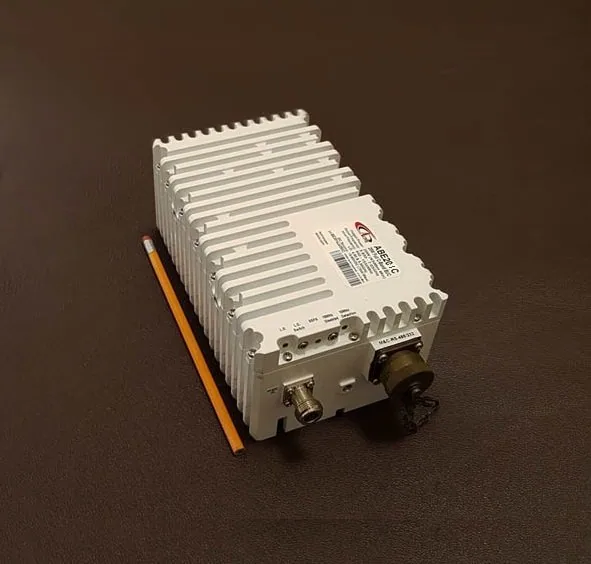
Actox 2W-400W C-Band Block Upconverter (BUC)
The Actox C-Band Block Upconverter is engineered for satellite communication systems working in the C-band frequency range, converting lower frequency signals from a modem up to the C-band frequencies required for satellite uplink. The range spans 2W to 400W across the ABE, ABC and ABD model families, covering extended C-band at 5.85-6.725 GHz and INSAT band at 6.725-7.025 GHz. High output power, low phase noise and excellent linearity, combined with advanced thermal management and a compact, robust build, suit fixed, mobile and maritime satellite communications.
Key Features
- Twenty-plus models from ABE2DC 2W to ABD400DC 400W cover the full C-band power spectrum
- Extended C-band units operate across 5.85-6.725 GHz for standard international uplinks
- Dedicated INSAT band models ABC60IC, ABC80IC and ABC100IC cover 6.725-7.025 GHz
- Fanless ABE20DC, ABE25DC and ABE30DC options remove a moving part from the failure list
- High output power, low phase noise and excellent linearity for clean, reliable transmission
- Advanced thermal management and robust build support long-term outdoor reliability
- Compact design allows straightforward integration into existing fixed or mobile systems
Technical Specifications
Typical Applications
- Fixed C-band earth stations and teleport uplinks requiring high rain availability
- Maritime VSAT and offshore energy platforms operating across tropical ocean regions
- Broadcast contribution, distribution and satellite news gathering over C-band capacity
- Government, defence and civil infrastructure networks needing resilient long-haul links
- Telecom operator trunking and cellular backhaul into remote regions of Asia and Africa
- Disaster recovery and emergency restoration where fade margin cannot be compromised
How the Actox C-Band BUC Turns a Modem Output Into a Satellite Uplink
The Actox C-Band Block Upconverter converts lower frequency signals coming from the satellite modem into the higher C-band frequencies needed for uplink transmission, and amplifies them to the level the antenna requires. Both functions live in one outdoor unit that mounts at the feed, which is the standard architecture because it avoids running amplified C-band power down a long, lossy waveguide. Actox specifies high output power, low phase noise and excellent linearity for this family, and each of those characteristics does real work: output power sets the EIRP you can achieve on a given dish, phase noise governs demodulator lock margin on narrow carriers, and linearity determines how hard you can drive the amplifier before intermodulation products spill into adjacent carriers. Advanced thermal management supports long-term reliability in demanding outdoor environments.
Extended C-Band and INSAT Band Coverage Explained
The Actox C-Band BUC range is split across two uplink segments. Most models are extended C-band units covering 5.85 to 6.725 GHz, which is the segment used by the majority of international C-band satellites and by regional operators across Asia, Africa and the Middle East. A separate group of models covers the INSAT band at 6.725 to 7.025 GHz, specifically the ABC60IC at 60W, the ABC80IC at 80W and the ABC100IC at 100W. Getting this right matters at the specification stage, because a BUC covering 5.85 to 6.725 GHz simply cannot reach an INSAT uplink allocation. Confirm the uplink frequency plan issued by your satellite operator before selecting a model, and check it again against the transponder assignment on your final service agreement.
Choosing an Actox C-Band BUC Model from 2W to 400W
Actox breaks the range into three model families. The ABE series covers the lower power points from the ABE2DC at 2W up to the ABE30DC at 30W, and includes fanless options at 20W, 25W and 30W that remove the fan as a wear item, which is worth having on remote unattended sites. The ABC series spans 40W to 100W with the ABC40DC, ABC50DC and the INSAT band ABC60IC, ABC80IC and ABC100IC. The ABD series carries the high-power end, from the ABD125DC at 125W through 135W, 180W, 200W, 220W and 250W to the ABD400DC at 400W. Your link budget sets the target: antenna aperture, satellite EIRP and G/T, modcod, symbol rate and required availability, plus back-off headroom so you never operate near compression.
Why Buy Actox C-Band BUCs from GCCSAT in the UAE
GCCSAT supplies Actox C-band amplifiers and the surrounding ground segment from the UAE into the GCC, wider Middle East and Africa. Working with a regional integrator means the BUC, antenna, feed components and modem are specified together and supported by one team, rather than assembled from separate import routes and separate vendors. Our engineers can help you identify the right Actox model, confirm whether you need extended C-band or an INSAT band unit, and check that the power point and mechanical envelope suit your mount. We support integration and commissioning work including feed and OMT matching, cross-polarisation and drive-level line-up with the satellite operator, and spares planning for multi-site networks. Individual model datasheets are available on request, and pricing for any configuration is quoted on request.
Frequently Asked Questions
What frequency range does the Actox C-Band BUC cover?
Most models in the range are extended C-band units covering 5.85 to 6.725 GHz. Actox also offers dedicated INSAT band models covering 6.725 to 7.025 GHz, specifically the ABC60IC at 60W, the ABC80IC at 80W and the ABC100IC at 100W. Confirm your satellite operator's uplink allocation before selecting between the two segments.
Which Actox C-band BUC models are available and at what power?
The ABE series runs from the ABE2DC at 2W to the ABE30DC at 30W, including fanless 20W, 25W and 30W units. The ABC series covers 40W to 100W. The ABD series covers 125W, 135W, 180W, 200W, 220W, 250W and the ABD400DC at 400W, giving a total range of 2W to 400W.
What is the advantage of a fanless BUC?
A fan is a moving part and therefore a wear item, and on an unattended remote site or a dusty desert installation it is often the first thing to fail. Actox offers fanless versions of the ABE20DC 20W, ABE25DC 25W and ABE30DC 30W units, which removes that failure mode and reduces the routine maintenance a terminal requires.
Is the Actox C-Band BUC suitable for maritime installations?
Yes. Actox states that the C-Band BUC is built for durability and consistent performance in demanding environments, and lists fixed, mobile and maritime satellite communications among its applications. As with any shipborne installation, your mount design should still address vibration, salt exposure and the stabilised antenna's own mechanical constraints.
Does GCCSAT ship Actox C-band BUCs to the GCC and Africa?
GCCSAT is a UAE-based satellite communications integrator supplying Actox C-band BUCs across the UAE, Saudi Arabia, Oman, Qatar, Kuwait, Bahrain and the wider Middle East and Africa region. Send us your antenna diameter, target satellite, uplink frequency allocation and throughput requirement and we will recommend a model and quote it on request.
Enquire About Actox 2W-400W C-Band Block Upconverter (BUC)
Our sales team will provide pricing, availability, and shipping details.
Request a QuoteWhatsAppMore VSAT BUC
- Amplus AM-9335 Series 5W Palapa C-Band BUC
- Amplus Series AM-9335 10W Full C-Band BUC
- iDirect 3W Universal BUC Ku-Band
- iDirect 4W Universal BUC Ku-Band
- NJRC NJT8302UF 3W Universal BUC Ku-Band
- NJRC NJT8306UF 6W Universal BUC Ku-Band
- NJRC NJT8318UF 8W Universal BUC Ku-Band
- NJRC NJT8319UF 16W Universal BUC Ku-Band
- NJRC NJT8370UF 25W GaN Universal BUC Ku-Band
- Terrasat 4W to 50W iBUC 2 Ku-Band
- Terrasat 5W to 80W iBUC 2 C-Band
- XMW M-T2940 / M-T29E40 / M-T3040 Ka-Band 40W Mobility BUC
- XMW M-TT2930 Ka Tri-Band 30W BUC
- XMW M-T2920 / M-T29E20 / M-T3020 Ka-Band 20W Mobility BUC
- XMW M-T2916 / M-T29E16 / M-T3016 Ka-Band 16W Mobility BUC
- XMW M-TD3010 Ka Dual-Band 10W Mobility BUC
- XMW M-T2908 / M-T29E08 / M-T3008 Ka-Band 8W Mobility BUC
- XMW T2705 / T2805 Ka-Band 5W Fanless BUC
- XMW TQ3001 Ka-Band Quad-Band 1W BUC
- XMW T13100 / T14100 Ku-Band 100W GaN BUC
- XMW T1380 / T1480 Ku-Band 80W GaN BUC
- XMW T1360 / T1460 Ku-Band 60W BUC
- XMW T1350 / T1450 Ku-Band 50W BUC
- XMW T1240 Ku-Band 40W BUC
- XMW M-T1225 Ku-Band 25W Mobility BUC
- XMW M-T1216 Ku-Band 16W Mobility BUC
- XMW T1208 Ku-Band 8W BUC
- XMW T1306-A Ku-Band 6W BUC
- XMW T1304-A Ku-Band 4W BUC
- XMW T1303-A Ku-Band 3W BUC
- XMW T Series C-Band 100W BUC (T50100 / T51100 / T52100 / T53100)
- XMW C-Band 50W BUC (T5050 / T5150 / T5250 / T5350 / T5450 / T6050)
- XMW C-Band 40W BUC (Block Upconverter)
- XMW M-T5030 Series C-Band 30W Mobility BUC
- XMW M-T5020 Series C-Band 20W Mobility BUC
- XMW T5010 Series C-Band 10W BUC
- Terrasat IBUC G 200W & 400W C-Band GaN BUC
- Terrasat IBUC R 100W-400W C-Band GaAs BUC/SSPA
- Terrasat IBUC G 150W-200W Ku-Band GaN BUC
- Terrasat IBUC R Ku-Band BUC 60W to 200W
- Teledyne Paradise SSPA C-Band and Ku-Band (Indoor and Outdoor)
- Nisshinbo NJT8316L 4W Lower Ku-Band BUC
- Nisshinbo NJT8315L 2W Lower Ku-Band BUC
- Nisshinbo NJT8371 40W Ku-Band BUC
- Nisshinbo NJT8370 25W Ku-Band BUC
- Nisshinbo NJT8319 16W Ku-Band BUC
- Nisshinbo NJT8318 8W Ku-Band BUC
- Nisshinbo NJT8376 6W Ku-Band BUC
- Nisshinbo NJT8304 4W Ku-Band BUC
- Nisshinbo NJT8302 3W Ku-Band BUC
- Nisshinbo NJT5762 10W C-Band BUC
- Nisshinbo NJT5669 5W C-Band BUC
- Nisshinbo NJT8102 2W C-Band BUC
- Nexgenwave Low Ku-Band G Series BUC 2W-80W Block Upconverter
- Amplus 3W-400W C-Band Block Upconverter (BUC)
- Amplus 4W-200W Ku-Band Block Upconverter (BUC)
- Actox 2W-250W Low Ku-Band BUC
- Actox 2W-300W Ku-Band Block Upconverter (BUC)
Product Categories
- VSAT BUC
- VSAT LNB
- VSAT Antennas
- VSAT Fixed Antennas
- VSAT Flyaway Antennas
- VSAT Maritime Antennas
- VSAT KingSat Antennas
- L-Band Satellite Terminals
- Cobham BGAN Terminals
- Thuraya L-Band Terminals
- VSAT Satellite Modems
- Satellite Phones
- Teltonika Products
- Sangfor Firewall & SD-WAN
- Thuraya Accessories
- Excelerate Hybrid Connectivity
- Peplink Products
- VSAT RF Components
- VSAT Hub & Test Equipment
- Remote Site Power Systems