
- Home
- Industries
Industries
Enabling transformation and progress across a wide range of industries globally, fostering innovation and growth in every sector.
Explore all → - Solutions
Connectivity
Connecting industries worldwide with reliable satellite internet solutions, driving innovation, efficiency, and growth across all sectors globally.
Explore all → - Services
Professional VSAT & IT Services
Delivering expert VSAT and IT solutions for seamless connectivity, reliability, and performance across all sectors.
Explore all → - Products
Superior Connectivity, Trusted Solutions
Offering premium Satcom products that guarantee reliable connectivity and boost innovation across industries.
Explore all → - Coverage
WorldWide Coverage
Delivering tailored satellite services that enhance connectivity, foster innovation, and support growth in every industry.
Explore all → - About
- Blog
- Contact
Nisshinbo NJT5762 10W C-Band BUC
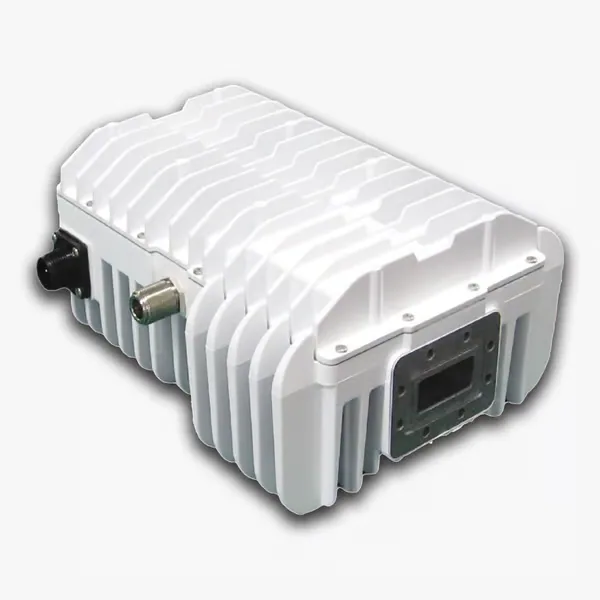
Nisshinbo NJT5762 10W C-Band BUC
The Nisshinbo NJT5762 is a 10 W C-band block upconverter covering the 5.85 to 6.425 GHz uplink from a 950 to 1,525 MHz L-band IF, using a 4.9 GHz local oscillator. It delivers +40 dBm minimum P1dB over temperature with third-order intermodulation of -28 dBc at +37 dBm output. FSK monitor and control is fitted as standard, the unit accepts +18 to +60 VDC with an AC power option, and the 3.2 kg housing carries an LED indicator for fast checks in the field.
Key Features
- 10 W class C-band output with +40 dBm minimum P1dB over temperature
- Covers the standard 5.85 to 6.425 GHz C-band uplink from L-band IF
- Third-order intermodulation held at -28 dBc when driven to +37 dBm
- FSK communications monitor and control equipped as standard
- Wide +18 to +60 VDC supply range with an AC power option available
- LED indicator for immediate local status confirmation during alignment
- RoHS compliant 3.2 kg outdoor unit for antenna-mounted installation
Technical Specifications
Typical Applications
- Tropical and monsoon region VSAT hubs and remotes
- Offshore energy platforms and maritime C-band terminals
- Broadcast contribution and distribution earth stations
- Government and telecom operator trunking links
- Rural telephony and cellular backhaul across Africa and Asia
- Disaster recovery earth stations requiring rain-fade resilience
Why C-Band Still Wins in Rain-Prone Regions
C-band operates at roughly a third of the frequency of Ku-band, and that single fact drives most of the engineering choices around it. Rain attenuation rises steeply with frequency, so a C-band link stays up through tropical downpours and monsoon conditions that would drop a Ku-band service on the same path. That is why C-band remains the backbone choice for operators across equatorial Africa, South and Southeast Asia and parts of the Gulf coastal belt where humidity and heavy seasonal rain are the norm. The trade-offs are real: antennas are larger for the same gain, and the band shares spectrum with terrestrial microwave services, so site coordination is required. Where availability targets are demanding and the site sees serious rain, C-band remains the pragmatic answer.
How the NJT5762 C-Band BUC Fits Into an Earth Station
The NJT5762 takes the L-band transmit output of a modem across 950 to 1,525 MHz and translates it upward with a 4.9 GHz local oscillator to produce 5.85 to 6.425 GHz, then amplifies to the 10 W class with +40 dBm minimum P1dB over temperature. Physically the unit mounts at or near the feed so the waveguide run stays short, with the interfacility cable carrying IF, DC and monitoring back to the equipment room. Because C-band losses in coax are lower than at Ku-band per unit length, and the outdoor unit itself is well suited to permanent installation, the NJT5762 is commonly found on fixed earth stations, telemetry sites and platform-mounted maritime antennas rather than in flyaway kits.
Monitoring, Power Options and Linearity in Service
FSK communications monitor and control is equipped on the NJT5762, letting the outdoor unit report status back over the interfacility link without an additional control cable. That is valuable on remote or hard-to-reach sites where a truck roll to read an indicator is expensive. Power flexibility helps as well: the wide +18 to +60 VDC range covers most terminal supplies and vehicle systems, and an AC power option is available where a local mains feed is simpler to provide. On the RF side, the published third-order intermodulation figure of -28 dBc at +37 dBm output is the number to design against for multi-carrier operation. Back the amplifier off from P1dB so intermodulation products remain within the operator mask across all carriers.
Why Buy Nisshinbo C-Band BUCs from GCCSAT in the UAE
GCCSAT is a UAE-based VSAT and satellite communications integrator supplying Nisshinbo C-band BUCs including the NJT5762 across the GCC, the wider Middle East and Africa. Customers deal with a regional team that understands both the technical requirement and the practical side of importing, documenting and delivering RF hardware into the region. We supply the NJT5762 individually or as part of a complete C-band chain with antenna, feed, LNB and modem, and we can review your link budget, drive levels and monitoring architecture before committing to a build. Integration, bench testing, commissioning support and spares planning are all available. Pricing is quoted on request against your specific configuration and quantity.
Frequently Asked Questions
What frequency range does the NJT5762 C-band BUC cover?
The NJT5762 transmits across 5.85 to 6.425 GHz, the standard C-band uplink segment. It accepts a 950 to 1,525 MHz L-band IF from the modem and translates it with a 4.9 GHz local oscillator. Enter that LO value into the modem so it can display and set absolute uplink frequencies for the assigned carrier.
What output power does the NJT5762 provide?
Nisshinbo specifies +40 dBm minimum at the 1 dB compression point over temperature, which is the 10 W class rating. Third-order intermodulation is quoted at -28 dBc with the unit driven to +37 dBm. For multi-carrier services, operate below P1dB so intermodulation products stay within the satellite operator spectral mask across the full carrier set.
Why choose C-band instead of Ku-band?
C-band suffers far less rain attenuation than Ku-band because it operates at a much lower frequency, so links stay available through tropical and monsoon rainfall. The trade-off is larger antennas for equivalent gain and the need for coordination with terrestrial microwave services sharing the band. For high-availability services in wet climates, C-band remains the standard engineering choice.
Does the NJT5762 support remote monitoring?
Yes. The NJT5762 is equipped with FSK communications monitor and control, so status can be reported over the interfacility link without running a separate control cable to the outdoor unit. An LED indicator on the housing also provides local confirmation during installation and alignment, which is useful when working at the antenna without access to the control system.
Can GCCSAT supply the NJT5762 to customers outside the UAE?
Yes. GCCSAT operates from the UAE and supplies C-band BUCs to customers across the GCC, the wider Middle East and Africa. We can quote the NJT5762 alone or as part of a full C-band earth station package, and we support integration, testing and commissioning. Contact our team with your requirement and pricing will be provided on request.
Enquire About Nisshinbo NJT5762 10W C-Band BUC
Our sales team will provide pricing, availability, and shipping details.
Request a QuoteWhatsAppMore VSAT BUC
- Amplus AM-9335 Series 5W Palapa C-Band BUC
- Amplus Series AM-9335 10W Full C-Band BUC
- iDirect 3W Universal BUC Ku-Band
- iDirect 4W Universal BUC Ku-Band
- NJRC NJT8302UF 3W Universal BUC Ku-Band
- NJRC NJT8306UF 6W Universal BUC Ku-Band
- NJRC NJT8318UF 8W Universal BUC Ku-Band
- NJRC NJT8319UF 16W Universal BUC Ku-Band
- NJRC NJT8370UF 25W GaN Universal BUC Ku-Band
- Terrasat 4W to 50W iBUC 2 Ku-Band
- Terrasat 5W to 80W iBUC 2 C-Band
- XMW M-T2940 / M-T29E40 / M-T3040 Ka-Band 40W Mobility BUC
- XMW M-TT2930 Ka Tri-Band 30W BUC
- XMW M-T2920 / M-T29E20 / M-T3020 Ka-Band 20W Mobility BUC
- XMW M-T2916 / M-T29E16 / M-T3016 Ka-Band 16W Mobility BUC
- XMW M-TD3010 Ka Dual-Band 10W Mobility BUC
- XMW M-T2908 / M-T29E08 / M-T3008 Ka-Band 8W Mobility BUC
- XMW T2705 / T2805 Ka-Band 5W Fanless BUC
- XMW TQ3001 Ka-Band Quad-Band 1W BUC
- XMW T13100 / T14100 Ku-Band 100W GaN BUC
- XMW T1380 / T1480 Ku-Band 80W GaN BUC
- XMW T1360 / T1460 Ku-Band 60W BUC
- XMW T1350 / T1450 Ku-Band 50W BUC
- XMW T1240 Ku-Band 40W BUC
- XMW M-T1225 Ku-Band 25W Mobility BUC
- XMW M-T1216 Ku-Band 16W Mobility BUC
- XMW T1208 Ku-Band 8W BUC
- XMW T1306-A Ku-Band 6W BUC
- XMW T1304-A Ku-Band 4W BUC
- XMW T1303-A Ku-Band 3W BUC
- XMW T Series C-Band 100W BUC (T50100 / T51100 / T52100 / T53100)
- XMW C-Band 50W BUC (T5050 / T5150 / T5250 / T5350 / T5450 / T6050)
- XMW C-Band 40W BUC (Block Upconverter)
- XMW M-T5030 Series C-Band 30W Mobility BUC
- XMW M-T5020 Series C-Band 20W Mobility BUC
- XMW T5010 Series C-Band 10W BUC
- Terrasat IBUC G 200W & 400W C-Band GaN BUC
- Terrasat IBUC R 100W-400W C-Band GaAs BUC/SSPA
- Terrasat IBUC G 150W-200W Ku-Band GaN BUC
- Terrasat IBUC R Ku-Band BUC 60W to 200W
- Teledyne Paradise SSPA C-Band and Ku-Band (Indoor and Outdoor)
- Nisshinbo NJT8316L 4W Lower Ku-Band BUC
- Nisshinbo NJT8315L 2W Lower Ku-Band BUC
- Nisshinbo NJT8371 40W Ku-Band BUC
- Nisshinbo NJT8370 25W Ku-Band BUC
- Nisshinbo NJT8319 16W Ku-Band BUC
- Nisshinbo NJT8318 8W Ku-Band BUC
- Nisshinbo NJT8376 6W Ku-Band BUC
- Nisshinbo NJT8304 4W Ku-Band BUC
- Nisshinbo NJT8302 3W Ku-Band BUC
- Nisshinbo NJT5669 5W C-Band BUC
- Nisshinbo NJT8102 2W C-Band BUC
- Nexgenwave Low Ku-Band G Series BUC 2W-80W Block Upconverter
- Amplus 3W-400W C-Band Block Upconverter (BUC)
- Amplus 4W-200W Ku-Band Block Upconverter (BUC)
- Actox 2W-250W Low Ku-Band BUC
- Actox 2W-400W C-Band Block Upconverter (BUC)
- Actox 2W-300W Ku-Band Block Upconverter (BUC)
Product Categories
- VSAT BUC
- VSAT LNB
- VSAT Antennas
- VSAT Fixed Antennas
- VSAT Flyaway Antennas
- VSAT Maritime Antennas
- VSAT KingSat Antennas
- L-Band Satellite Terminals
- Cobham BGAN Terminals
- Thuraya L-Band Terminals
- VSAT Satellite Modems
- Satellite Phones
- Teltonika Products
- Sangfor Firewall & SD-WAN
- Thuraya Accessories
- Excelerate Hybrid Connectivity
- Peplink Products
- VSAT RF Components
- VSAT Hub & Test Equipment
- Remote Site Power Systems