
- Home
- Industries
Industries
Enabling transformation and progress across a wide range of industries globally, fostering innovation and growth in every sector.
Explore all → - Solutions
Connectivity
Connecting industries worldwide with reliable satellite internet solutions, driving innovation, efficiency, and growth across all sectors globally.
Explore all → - Services
Professional VSAT & IT Services
Delivering expert VSAT and IT solutions for seamless connectivity, reliability, and performance across all sectors.
Explore all → - Products
Superior Connectivity, Trusted Solutions
Offering premium Satcom products that guarantee reliable connectivity and boost innovation across industries.
Explore all → - Coverage
WorldWide Coverage
Delivering tailored satellite services that enhance connectivity, foster innovation, and support growth in every industry.
Explore all → - About
- Blog
- Contact
Nisshinbo NJT8376 6W Ku-Band BUC
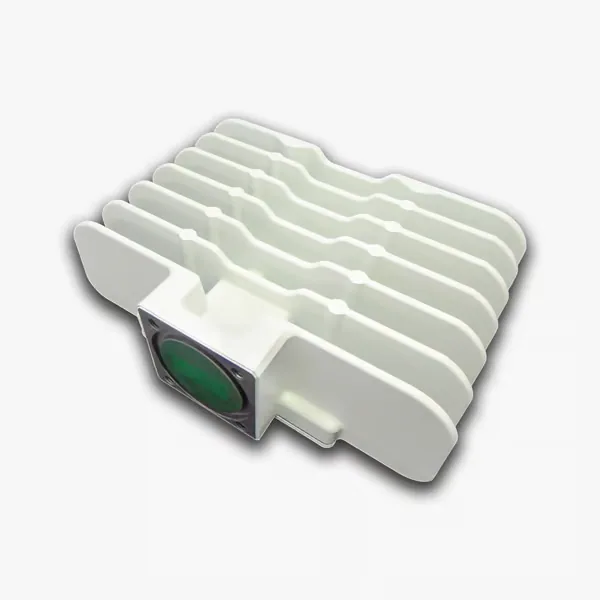
Nisshinbo NJT8376 6W Ku-Band BUC
The Nisshinbo NJT8376 is a 6 W Ku-band block upconverter built into an ultra-light 540 g housing. It accepts a 950 to 1,450 MHz L-band IF and translates it to the 14.0 to 14.5 GHz uplink with a 13.05 GHz local oscillator, delivering +37.8 dBm minimum P1dB over temperature and holding -26 dBc ACPR at +37.0 dBm output. Drawing 34 W, the NJT8376 is well suited to flyaway cases, vehicular systems and small fixed VSAT antennas where mass at the feed arm and DC budget both matter.
Key Features
- Ultra-compact 540 g body cuts feed-arm mass on flyaway and small antennas
- Covers the complete 14.0 to 14.5 GHz Ku-band satellite uplink segment
- Maintains +37.8 dBm minimum P1dB across the operating temperature range
- Low distortion output with -26 dBc ACPR measured at +37.0 dBm
- 34 W consumption eases DC budgets on battery and solar-backed terminals
- Standard 950 to 1,450 MHz L-band IF interface for common VSAT modems
- RoHS compliant construction suited to international deployment programmes
Technical Specifications
Typical Applications
- Flyaway and manpack VSAT terminals for field teams
- Vehicle-mounted comms-on-the-pause and SNG systems
- Maritime and inland waterway stabilised antennas
- Enterprise branch and remote site broadband terminals
- Emergency response and humanitarian deployment kits
- Temporary event and outside broadcast connectivity
Where a 6 W Ku-Band BUC Like the NJT8376 Makes Sense
Six watts occupies a useful place in the Ku-band lineup. It gives noticeably more headroom than the 2 W to 4 W units used on the smallest terminals, yet avoids the mass, heat and DC draw that come with 16 W and larger amplifiers. On a portable or vehicle-mounted antenna that trade-off is usually decisive. The NJT8376 delivers +37.8 dBm minimum P1dB over temperature while consuming 34 W, so a modest generator, vehicle alternator or battery bank can sustain it. Typical uses include remote enterprise sites carrying data and voice, field teams running video return over a small aperture, and maritime terminals where antenna size is capped by deck space. As always, the achievable data rate depends on antenna gain, satellite performance and modulation scheme rather than on BUC power alone.
Weight, Power Draw and Portable Terminal Design
At 540 g the NJT8376 is light enough to change the mechanical design of a terminal, not merely its packing list. Mass hanging off a feed arm loads the positioner, affects pointing stability in wind, and drives the size of the drive motors on any tracking system. Shaving hundreds of grams at that end of the lever arm has a disproportionate effect on the whole assembly. Similarly, a 34 W draw shortens the list of compromises when the terminal runs on batteries, on a small inverter or on a solar array. For case-packed flyaway systems it also means the BUC can travel installed on the feed rather than as a separate boxed item, which removes an assembly step and a potential connector fault during deployment.
Integrating the NJT8376 Into a VSAT Transmit Chain
The NJT8376 presents a conventional interface to the rest of the terminal: an L-band IF input covering 950 to 1,450 MHz and an RF output on the 14.0 to 14.5 GHz uplink, related by the fixed 13.05 GHz local oscillator. In practice that means any modem producing a standard Ku-band L-band transmit output can drive it, provided the modem output level is matched to the gain of the unit so the amplifier is neither starved nor overdriven. Set transmit levels at commissioning with a spectrum analyser rather than trusting nominal figures, and record the modem attenuation that produces the operator-assigned EIRP. Confirm reference signal, DC injection and connector details against the NJT8376 datasheet before you specify the interfacility cable and mounting bracket.
Buying Nisshinbo Ku-Band BUCs from GCCSAT in the UAE
GCCSAT is a UAE-based satellite communications integrator supplying Nisshinbo BUCs across the Emirates, the GCC and the wider Middle East and Africa. Buyers get a regional point of contact for technical questions, order handling and after-sales support rather than a long-distance transaction. We routinely specify the NJT8376 alongside antennas, LNBs, modems and cabling, so we can review a full bill of materials and flag mismatches in gain, power or interface before anything ships. Our services extend to bench verification, terminal integration, on-site commissioning and spares planning for fleets of terminals. Pricing for the NJT8376 is quoted on request. Share your antenna size, service profile and deployment environment and we will respond with a recommended configuration and a formal quotation.
Frequently Asked Questions
What frequency range does the NJT8376 cover?
The NJT8376 covers the 14.0 to 14.5 GHz Ku-band uplink. Its input is a 950 to 1,450 MHz L-band IF, and a fixed 13.05 GHz local oscillator performs the translation between the two. That gives continuous coverage of the standard Ku-band transmit segment used by most commercial satellite operators, without any band switching or tuning at the outdoor unit.
How heavy is the NJT8376 and why does weight matter?
The NJT8376 weighs 540 g. On a feed arm, mass affects pointing stability in wind, loads the positioner and drives the sizing of tracking motors. On portable systems it also affects what a two-person team can carry and assemble. An ultra-light BUC therefore simplifies mechanical design for flyaway, vehicular and small maritime antennas.
How much power does the NJT8376 consume?
Nisshinbo rates the NJT8376 at 34 W power consumption. That figure is important for terminals running on batteries, vehicle supplies or solar arrays, where the outdoor unit is often the largest single load. Lower consumption also means less waste heat inside the enclosure, which helps in high ambient temperatures typical of Gulf and desert deployments.
What does ACPR of -26 dBc at +37.0 dBm mean in practice?
Adjacent channel power ratio measures how much energy the amplifier spills into neighbouring channels as it nears compression. Nisshinbo specifies -26 dBc for the NJT8376 at +37.0 dBm output. Satellite operators check this during carrier line-up, so it sets the practical limit on how hard you can drive the unit before interference into adjacent carriers becomes unacceptable.
Can GCCSAT supply the NJT8376 as part of a complete terminal?
Yes. GCCSAT supplies the NJT8376 on its own or integrated with an antenna, LNB, modem and cabling as a complete Ku-band terminal. Our UAE base supports customers across the GCC, Middle East and Africa, and we assist with integration, testing and commissioning. Contact us with your requirement and pricing will be quoted on request.
Enquire About Nisshinbo NJT8376 6W Ku-Band BUC
Our sales team will provide pricing, availability, and shipping details.
Request a QuoteWhatsAppMore VSAT BUC
- Amplus AM-9335 Series 5W Palapa C-Band BUC
- Amplus Series AM-9335 10W Full C-Band BUC
- iDirect 3W Universal BUC Ku-Band
- iDirect 4W Universal BUC Ku-Band
- NJRC NJT8302UF 3W Universal BUC Ku-Band
- NJRC NJT8306UF 6W Universal BUC Ku-Band
- NJRC NJT8318UF 8W Universal BUC Ku-Band
- NJRC NJT8319UF 16W Universal BUC Ku-Band
- NJRC NJT8370UF 25W GaN Universal BUC Ku-Band
- Terrasat 4W to 50W iBUC 2 Ku-Band
- Terrasat 5W to 80W iBUC 2 C-Band
- XMW M-T2940 / M-T29E40 / M-T3040 Ka-Band 40W Mobility BUC
- XMW M-TT2930 Ka Tri-Band 30W BUC
- XMW M-T2920 / M-T29E20 / M-T3020 Ka-Band 20W Mobility BUC
- XMW M-T2916 / M-T29E16 / M-T3016 Ka-Band 16W Mobility BUC
- XMW M-TD3010 Ka Dual-Band 10W Mobility BUC
- XMW M-T2908 / M-T29E08 / M-T3008 Ka-Band 8W Mobility BUC
- XMW T2705 / T2805 Ka-Band 5W Fanless BUC
- XMW TQ3001 Ka-Band Quad-Band 1W BUC
- XMW T13100 / T14100 Ku-Band 100W GaN BUC
- XMW T1380 / T1480 Ku-Band 80W GaN BUC
- XMW T1360 / T1460 Ku-Band 60W BUC
- XMW T1350 / T1450 Ku-Band 50W BUC
- XMW T1240 Ku-Band 40W BUC
- XMW M-T1225 Ku-Band 25W Mobility BUC
- XMW M-T1216 Ku-Band 16W Mobility BUC
- XMW T1208 Ku-Band 8W BUC
- XMW T1306-A Ku-Band 6W BUC
- XMW T1304-A Ku-Band 4W BUC
- XMW T1303-A Ku-Band 3W BUC
- XMW T Series C-Band 100W BUC (T50100 / T51100 / T52100 / T53100)
- XMW C-Band 50W BUC (T5050 / T5150 / T5250 / T5350 / T5450 / T6050)
- XMW C-Band 40W BUC (Block Upconverter)
- XMW M-T5030 Series C-Band 30W Mobility BUC
- XMW M-T5020 Series C-Band 20W Mobility BUC
- XMW T5010 Series C-Band 10W BUC
- Terrasat IBUC G 200W & 400W C-Band GaN BUC
- Terrasat IBUC R 100W-400W C-Band GaAs BUC/SSPA
- Terrasat IBUC G 150W-200W Ku-Band GaN BUC
- Terrasat IBUC R Ku-Band BUC 60W to 200W
- Teledyne Paradise SSPA C-Band and Ku-Band (Indoor and Outdoor)
- Nisshinbo NJT8316L 4W Lower Ku-Band BUC
- Nisshinbo NJT8315L 2W Lower Ku-Band BUC
- Nisshinbo NJT8371 40W Ku-Band BUC
- Nisshinbo NJT8370 25W Ku-Band BUC
- Nisshinbo NJT8319 16W Ku-Band BUC
- Nisshinbo NJT8318 8W Ku-Band BUC
- Nisshinbo NJT8304 4W Ku-Band BUC
- Nisshinbo NJT8302 3W Ku-Band BUC
- Nisshinbo NJT5762 10W C-Band BUC
- Nisshinbo NJT5669 5W C-Band BUC
- Nisshinbo NJT8102 2W C-Band BUC
- Nexgenwave Low Ku-Band G Series BUC 2W-80W Block Upconverter
- Amplus 3W-400W C-Band Block Upconverter (BUC)
- Amplus 4W-200W Ku-Band Block Upconverter (BUC)
- Actox 2W-250W Low Ku-Band BUC
- Actox 2W-400W C-Band Block Upconverter (BUC)
- Actox 2W-300W Ku-Band Block Upconverter (BUC)
Product Categories
- VSAT BUC
- VSAT LNB
- VSAT Antennas
- VSAT Fixed Antennas
- VSAT Flyaway Antennas
- VSAT Maritime Antennas
- VSAT KingSat Antennas
- L-Band Satellite Terminals
- Cobham BGAN Terminals
- Thuraya L-Band Terminals
- VSAT Satellite Modems
- Satellite Phones
- Teltonika Products
- Sangfor Firewall & SD-WAN
- Thuraya Accessories
- Excelerate Hybrid Connectivity
- Peplink Products
- VSAT RF Components
- VSAT Hub & Test Equipment
- Remote Site Power Systems