
- Home
- Industries
Industries
Enabling transformation and progress across a wide range of industries globally, fostering innovation and growth in every sector.
Explore all → - Solutions
Connectivity
Connecting industries worldwide with reliable satellite internet solutions, driving innovation, efficiency, and growth across all sectors globally.
Explore all → - Services
Professional VSAT & IT Services
Delivering expert VSAT and IT solutions for seamless connectivity, reliability, and performance across all sectors.
Explore all → - Products
Superior Connectivity, Trusted Solutions
Offering premium Satcom products that guarantee reliable connectivity and boost innovation across industries.
Explore all → - Coverage
WorldWide Coverage
Delivering tailored satellite services that enhance connectivity, foster innovation, and support growth in every industry.
Explore all → - About
- Blog
- Contact
XMW BPF-3423-36 C-Band Bandpass Filter
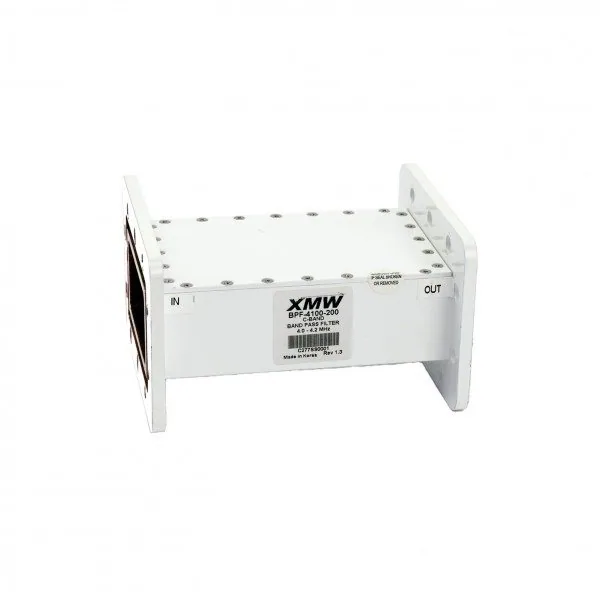
XMW BPF-3423-36 C-Band Bandpass Filter
The XMW BPF-3423-36 is a narrowband C-band bandpass filter covering 3405 to 3441 MHz with a 36 MHz passband, the classic width of a single satellite transponder channel. It combines very low 0.6 dB in-band insertion loss with steep skirts, providing 25 dB rejection at CF±68 MHz and 60 dB at CF±168 MHz. The BPF-3423-36 uses CPR229 waveguide interfaces on input and output, and XMW notes that other centre frequencies are available, making it a practical channel filter for C-band earth station front ends.
Key Features
- Narrow 36 MHz passband matches a single conventional satellite transponder channel
- Very low 0.6 dB in-band insertion loss preserves receive system G/T
- 60 dB rejection at CF±168 MHz gives strong protection from adjacent-band energy
- CPR229 waveguide flanges on both ports for direct feed-chain integration
- Other centre frequencies available from XMW on request for custom channel plans
- Passive waveguide construction requires no power, tuning or maintenance in service
Technical Specifications
Typical Applications
- C-band earth station and teleport antenna feed chains
- Single-transponder channel filtering ahead of an LNA or LNB
- Broadcast and video contribution C-band receive systems
- Government and defence fixed satellite ground segment
- Mining, oil and gas remote site C-band VSAT terminals
- Interference mitigation retrofits at existing gateway sites
Channel Filtering With the C-Band BPF-3423-36
Where a broadband filter protects a whole downlink block, the BPF-3423-36 works at channel level. Its 36 MHz passband centred in the 3405 to 3441 MHz range corresponds to the width of a single conventional satellite transponder, so it can isolate one carrier and reject everything else that reaches the antenna. That is valuable at congested sites where a strong neighbouring carrier or terrestrial emitter is desensitising a receiver even though the wanted carrier itself is healthy. The trade-off of narrow filtering is normally insertion loss, but at 0.6 dB the BPF-3423-36 costs very little in noise performance, which matters because any loss ahead of the low-noise amplifier translates almost directly into degraded system G/T.
Reading the Rejection Curve Before You Specify
Rejection numbers only mean something relative to where your interferer sits. XMW quotes 25 dB at 68 MHz either side of centre frequency and 60 dB at 168 MHz either side for the BPF-3423-36, which describes a filter that reaches its deepest quoted rejection at the 168 MHz offset. Before ordering, plot your own spectrum: identify the offending signal, measure its offset from your wanted centre frequency and its level, then check whether the filter delivers enough attenuation at that offset. If the interferer sits inside 68 MHz of centre you will need either a different centre frequency variant or a different mitigation approach entirely, such as antenna repointing, shielding or a site relocation study.
CPR229 Waveguide Installation Notes
The BPF-3423-36 presents CPR229 flanges, the standard C-band waveguide interface, so it bolts directly into a conventional feed chain without transitions. Use the correct gasket and a full complement of bolts, torque them evenly in a cross pattern, and check flange faces for burrs before mating, since a poor waveguide joint produces reflections and moisture ingress paths that are difficult to trace later. On outdoor runs, weatherproof the joint properly and maintain the pressurisation or desiccant arrangement used elsewhere in the feed. Where the filter is fitted ahead of an LNA, keep the waveguide run between them as short as practical so that filter loss stays the dominant, and known, contributor to noise temperature.
Why Source XMW C-Band Filters Through GCCSAT
GCCSAT is a UAE-based satellite communications integrator serving operators, teleports, broadcasters and government customers throughout the GCC and the wider Middle East. We supply XMW filters such as the BPF-3423-36 as part of complete RF front-end packages, alongside feeds, amplifiers and waveguide components, so that flange standards and frequency plans are checked once at the design stage rather than discovered on site. Because XMW offers other centre frequencies in this family, we can help you specify the exact channel your network needs rather than compromising on a stock passband. Our team supports installation, integration and commissioning across the region, and pricing for the BPF-3423-36 is quoted on request.
Frequently Asked Questions
What frequency range and bandwidth does the BPF-3423-36 cover?
The BPF-3423-36 passes 3405 to 3441 MHz, a bandwidth of 36 MHz within C-band. That width corresponds to a single conventional satellite transponder channel, which is why the filter is typically used to isolate one carrier rather than a whole downlink block. XMW states that other centre frequencies are available in this family.
How much insertion loss does the BPF-3423-36 add to the receive chain?
In-band insertion loss is specified at 0.6 dB. That figure matters most when the filter is placed ahead of the low-noise amplifier, because loss at that point adds almost directly to system noise temperature and reduces G/T. At 0.6 dB the impact is modest, and it is generally a worthwhile exchange for 60 dB of stopband rejection.
What waveguide interface does the BPF-3423-36 use?
Both ports use CPR229 waveguide flanges, the standard C-band waveguide interface. This lets the filter drop straight into a conventional C-band feed chain without transitions or adapters. Ensure you have the matching gasket, bolt set and, where the joint is outdoors, an appropriate weatherproofing and pressurisation arrangement.
What is the difference between a bandpass filter and a band reject filter?
A bandpass filter such as the BPF-3423-36 passes a defined window of spectrum and attenuates everything outside it. A band reject or notch filter does the opposite, passing the majority of the spectrum while attenuating one specific slice. Choose a bandpass filter when you know exactly which carrier you want; choose a notch when you must remove one known interferer and keep the rest.
Can GCCSAT supply the BPF-3423-36 with a different centre frequency?
XMW states that other frequencies are available in the BPF-3423 family, so a variant matched to your channel plan can usually be specified. Send GCCSAT your required centre frequency, bandwidth and the offset of any known interferer, and our team will confirm the appropriate configuration. Pricing and datasheets are provided on request.
Enquire About XMW BPF-3423-36 C-Band Bandpass Filter
Our sales team will provide pricing, availability, and shipping details.
Request a QuoteWhatsAppMore VSAT RF Components
- XMW BPF-1219-400 L-Band Bandpass Filter
- XMW BPF-1000-30 L-Band Bandpass Filter
- XMW BPF-CX-CF-BW C-Band Bandpass Filter Series
- XMW BPF-CF-BW (BPF-C-1 to BPF-C-6) C-Band Bandpass Filters
- XMW BPF-7500-500 X-Band Bandpass Filter
- XMW BPF-11600-1800 Ku-Band Bandpass Filter
- Times Microwave N-Type and F-Type Coaxial Connectors
- Times Microwave LMR400, LMR600, RG6 and RG11 Coaxial Cables
- Norsat OMT-KUE Ku-Band Extended OMT Transmit Reject Filter
- Norsat C-Band Band Pass Filter (BPF)
- Nexgenwave Low Ku-Band Waveguide Rejection Filter
- Jupiter Microwave Flexible Waveguide (C-Band and Ku-Band)
- ELT Systems Passive Combiner-Splitter (L-Band and S-Band)
- ELT Systems TEEL1-4007 Bias Tee
- ELT Systems XX-435000 RF Attenuator (3, 6, 10 and 20 dB)
- ELT Systems L-Band and IF-Band Active Splitter (2 to 16-Way)
- ELT Systems L-Band Active Combiner (2, 4, 8 and 16-Way)
- Actox Bias-T DC Power Injector (ABT6AN, ABT6AON, ABT6ARS)
Product Categories
- VSAT BUC
- VSAT LNB
- VSAT Antennas
- VSAT Fixed Antennas
- VSAT Flyaway Antennas
- VSAT Maritime Antennas
- VSAT KingSat Antennas
- L-Band Satellite Terminals
- Cobham BGAN Terminals
- Thuraya L-Band Terminals
- VSAT Satellite Modems
- Satellite Phones
- Teltonika Products
- Sangfor Firewall & SD-WAN
- Thuraya Accessories
- Excelerate Hybrid Connectivity
- Peplink Products
- VSAT RF Components
- VSAT Hub & Test Equipment
- Remote Site Power Systems