
- Home
- Industries
Industries
Enabling transformation and progress across a wide range of industries globally, fostering innovation and growth in every sector.
Explore all → - Solutions
Connectivity
Connecting industries worldwide with reliable satellite internet solutions, driving innovation, efficiency, and growth across all sectors globally.
Explore all → - Services
Professional VSAT & IT Services
Delivering expert VSAT and IT solutions for seamless connectivity, reliability, and performance across all sectors.
Explore all → - Products
Superior Connectivity, Trusted Solutions
Offering premium Satcom products that guarantee reliable connectivity and boost innovation across industries.
Explore all → - Coverage
WorldWide Coverage
Delivering tailored satellite services that enhance connectivity, foster innovation, and support growth in every industry.
Explore all → - About
- Blog
- Contact
XMW BPF-1219-400 L-Band Bandpass Filter
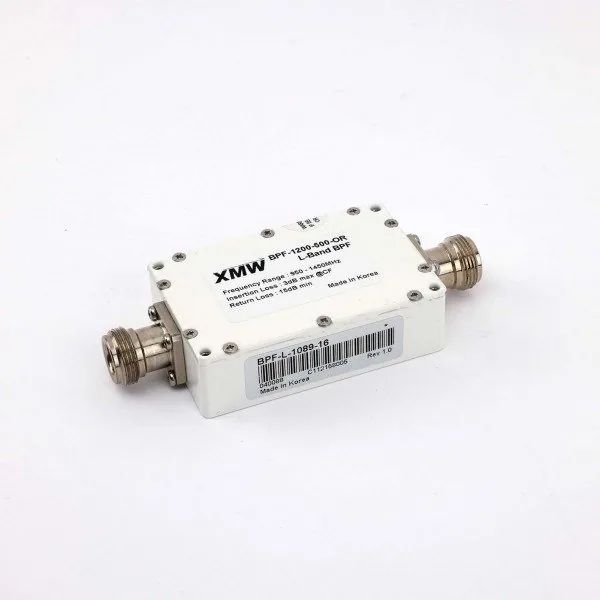
XMW BPF-1219-400 L-Band Bandpass Filter
The XMW BPF-1219-400 is an L-band bandpass filter with a 1019-1419 MHz passband and 400 MHz of usable bandwidth, built to keep out-of-band energy away from sensitive L-band receive and IF equipment. It offers 3 dB in-band insertion loss, 15 dB rejection at CF±300 MHz and 30 dB at CF±350 MHz, and is available with N, F or BNC connectors. The BPF-1219-400 is normally fitted inline between an LNB, downconverter and modem in VSAT and satellite ground terminals.
Key Features
- Wide 400 MHz L-band passband spanning 1019 to 1419 MHz for multi-carrier blocks
- 30 dB rejection at CF±350 MHz suppresses distant out-of-band interferers
- Moderate 3 dB in-band insertion loss keeps IF gain budgeting straightforward
- Choice of N, F or BNC input and output connectors for rack flexibility
- Fully passive design adds no active components or power draw to the chain
- Compact inline format suits both fixed teleport racks and transportable terminals
Technical Specifications
Typical Applications
- VSAT hub and remote terminal L-band IF receive chains
- Maritime and offshore energy stabilised satellite terminals
- Broadcast contribution, SNG and DSNG flyaway systems
- Teleport and gateway earth station IF distribution racks
- Government, defence and public safety ground segment
- Enterprise satellite backhaul and disaster recovery links
How the BPF-1219-400 Fits Into an L-Band VSAT Chain
In a modern satellite ground terminal the L-band IF is where block-downconverted receive spectrum and modulator output both live, so it is also where unwanted energy is easiest to pick up. The XMW BPF-1219-400 sits inline in that path and passes only the 1019-1419 MHz window, attenuating energy far enough outside it that downstream demodulators, gain stages and spectrum monitoring equipment see a cleaner input. Because the filter is entirely passive it introduces no noise of its own beyond the stated 3 dB in-band insertion loss, which a link budget can usually absorb by rebalancing IF gain earlier or later in the chain. Integrators typically fit one filter per receive port, or one per carrier branch where a splitter feeds several modems.
Choosing the Right L-Band Bandpass Filter
Filter selection in L-band comes down to three trade-offs: how much spectrum you actually need, how far the interferer sits from your carrier, and how much insertion loss the link can tolerate. A wide device such as the BPF-1219-400, with 400 MHz of bandwidth, keeps a large block of transponder spectrum intact while still delivering 15 dB of rejection 300 MHz from centre frequency and 30 dB at 350 MHz. If your interference source sits closer to the passband edge, a narrower design with steeper skirts is the better answer, at the cost of usable bandwidth. Confirm the connector standard early too, since this unit is offered with N, F or BNC interfaces and mixing connector families across a rack is a common source of avoidable loss and VSWR problems.
Installation and Integration Notes
Passive filters are simple to fit but easy to compromise. Mount the BPF-1219-400 close to the equipment you are protecting rather than at the far end of a long coaxial run, so the interfering signal is removed before it can saturate an amplifier stage. Keep interconnecting cable short, torque connectors properly, and confirm the DC path before you cut into a live line: many L-band runs carry LNB or BUC supply voltage and reference tone, so verify DC handling against the datasheet before inserting any filter into a powered feed. After installation, sweep the path with a spectrum analyser and archive the before and after traces. That record is the fastest way to prove the filter solved the problem and the easiest reference for the next site.
Why Buy XMW L-Band Bandpass Filters from GCCSAT in the UAE
GCCSAT supplies XMW RF components to satellite operators, teleports, systems integrators and government users across the UAE and the wider GCC and Middle East region. We can quote the BPF-1219-400 alongside the rest of the XMW L-band, C-band, X-band and Ku-band filter range, so a project is specified as one coordinated bill of materials instead of being chased across several vendors. Our engineers advise on passband selection, connector configuration and where the filter belongs in your IF chain, and we support installation, integration and commissioning for terminals deployed in the region. Datasheets and pricing for the BPF-1219-400 are provided on request; send us your frequency plan and interference profile and we will confirm the right configuration.
Frequently Asked Questions
What frequency range does the XMW BPF-1219-400 cover?
The BPF-1219-400 has a passband of 1019 to 1419 MHz, giving 400 MHz of bandwidth within the L-band IF range used by satellite terminals. Everything inside that window passes with approximately 3 dB of in-band insertion loss, while signals sufficiently far outside it are attenuated according to the published rejection figures.
How much out-of-band rejection does the BPF-1219-400 provide?
XMW specifies 15 dB of rejection at 300 MHz either side of centre frequency and 30 dB at 350 MHz either side. Insertion loss at 10 MHz is quoted as 1 dB. If your interfering carrier sits nearer to the passband edge than those offsets, a narrower filter with steeper skirts will give better protection.
What connectors are available on the BPF-1219-400?
The filter is offered with N, F or BNC input and output connectors, so it can be matched to existing teleport, broadcast or VSAT rack conventions without adapters. Adapters add loss and reflection points, so it is worth ordering the connector type that matches your installed cable assemblies from the outset.
Why does a VSAT terminal need an L-band bandpass filter?
L-band IF cabling runs through crowded electromagnetic environments and can pick up terrestrial transmissions, harmonics and intermodulation products. A bandpass filter passes only the wanted block and attenuates the rest, preventing strong out-of-band signals from compressing downstream amplifiers or degrading demodulator performance, which usually shows up as unexplained Eb/No loss.
Does GCCSAT supply the BPF-1219-400 in the UAE and wider GCC?
Yes. GCCSAT supplies XMW RF components including the BPF-1219-400 to customers across the UAE, the GCC and the broader Middle East, with support for integration and commissioning. Pricing is quoted on request. Contact our team with your frequency plan and we will confirm the correct filter variant and connector option.
Enquire About XMW BPF-1219-400 L-Band Bandpass Filter
Our sales team will provide pricing, availability, and shipping details.
Request a QuoteWhatsAppMore VSAT RF Components
- XMW BPF-3423-36 C-Band Bandpass Filter
- XMW BPF-1000-30 L-Band Bandpass Filter
- XMW BPF-CX-CF-BW C-Band Bandpass Filter Series
- XMW BPF-CF-BW (BPF-C-1 to BPF-C-6) C-Band Bandpass Filters
- XMW BPF-7500-500 X-Band Bandpass Filter
- XMW BPF-11600-1800 Ku-Band Bandpass Filter
- Times Microwave N-Type and F-Type Coaxial Connectors
- Times Microwave LMR400, LMR600, RG6 and RG11 Coaxial Cables
- Norsat OMT-KUE Ku-Band Extended OMT Transmit Reject Filter
- Norsat C-Band Band Pass Filter (BPF)
- Nexgenwave Low Ku-Band Waveguide Rejection Filter
- Jupiter Microwave Flexible Waveguide (C-Band and Ku-Band)
- ELT Systems Passive Combiner-Splitter (L-Band and S-Band)
- ELT Systems TEEL1-4007 Bias Tee
- ELT Systems XX-435000 RF Attenuator (3, 6, 10 and 20 dB)
- ELT Systems L-Band and IF-Band Active Splitter (2 to 16-Way)
- ELT Systems L-Band Active Combiner (2, 4, 8 and 16-Way)
- Actox Bias-T DC Power Injector (ABT6AN, ABT6AON, ABT6ARS)
Product Categories
- VSAT BUC
- VSAT LNB
- VSAT Antennas
- VSAT Fixed Antennas
- VSAT Flyaway Antennas
- VSAT Maritime Antennas
- VSAT KingSat Antennas
- L-Band Satellite Terminals
- Cobham BGAN Terminals
- Thuraya L-Band Terminals
- VSAT Satellite Modems
- Satellite Phones
- Teltonika Products
- Sangfor Firewall & SD-WAN
- Thuraya Accessories
- Excelerate Hybrid Connectivity
- Peplink Products
- VSAT RF Components
- VSAT Hub & Test Equipment
- Remote Site Power Systems