
- Home
- Industries
Industries
Enabling transformation and progress across a wide range of industries globally, fostering innovation and growth in every sector.
Explore all → - Solutions
Connectivity
Connecting industries worldwide with reliable satellite internet solutions, driving innovation, efficiency, and growth across all sectors globally.
Explore all → - Services
Professional VSAT & IT Services
Delivering expert VSAT and IT solutions for seamless connectivity, reliability, and performance across all sectors.
Explore all → - Products
Superior Connectivity, Trusted Solutions
Offering premium Satcom products that guarantee reliable connectivity and boost innovation across industries.
Explore all → - Coverage
WorldWide Coverage
Delivering tailored satellite services that enhance connectivity, foster innovation, and support growth in every industry.
Explore all → - About
- Blog
- Contact
ELT Systems TEEL1-4007 Bias Tee
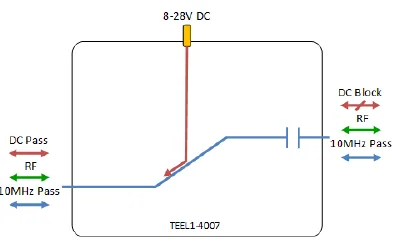
ELT Systems TEEL1-4007 Bias Tee
The ELT Systems Bias Tee (TEEL1-4007) combines DC power with an RF signal on a single coaxial run, so active devices such as LNAs and line amplifiers can be powered from the equipment rack rather than at the antenna. It offers wide frequency coverage, minimal insertion loss and high isolation between the RF and DC paths, which keeps power injection from degrading the signal. Built for durable, consistent operation, the TEEL1-4007 suits satellite communication and general RF systems.
Key Features
- Combines DC power and RF traffic on a single coaxial run to the antenna
- Remotely powers active components such as line amplifiers and LNAs
- Wide frequency coverage suits satellite communications and general RF distribution
- Minimal insertion loss so power injection does not erode link margin
- High isolation between RF and DC paths protects connected indoor equipment
- Durable construction for consistent performance in demanding environments
- Backed by the ELT Systems Bias Tee TEEL1-4007 v5.3 datasheet
Technical Specifications
Typical Applications
- Maritime VSAT terminals powering mast-mounted active RF devices over one coaxial run
- Offshore energy platforms where running mains power to the antenna is impractical
- Broadcast and SNG flyaway systems that need fast, simple RF cabling
- Government and defence communications shelters and transportable terminals
- Teleport and hub racks feeding remotely mounted amplifiers and LNAs
- Field commissioning and test benches requiring temporary DC injection
How a Bias Tee Powers Active RF Components
A bias tee sits in the coaxial path between an indoor unit and an outdoor active device, adding DC onto the same cable that already carries the RF signal. Internally, an inductive path passes DC toward the powered port while blocking RF from reaching the supply, and a capacitive path passes RF while blocking DC from returning toward the modem or receiver. The result is one cable to the antenna instead of two. That cuts installation cost, reduces the number of weatherproofed entries into a radome or mast, and removes the need for a mains outlet at the antenna itself. The ELT Systems Bias Tee is built for exactly this role, with high isolation between the RF and DC paths so the injected supply does not degrade the traffic passing through it.
Where the TEEL1-4007 Bias Tee Fits Into a VSAT Terminal
In a typical VSAT installation the TEEL1-4007 sits on the coaxial run between the indoor equipment and the antenna, powering an LNA, a line amplifier or another active element mounted outside. Integrators reach for it during system build-out when a device needs remote DC, and again during troubleshooting when a supply has to be injected without rewiring the rack. Because the ELT Systems Bias Tee offers wide frequency coverage and minimal insertion loss, it can usually be dropped into an existing chain with little effect on the level plan. When specifying one, match the DC voltage and current your powered device draws against the ratings published in the Bias Tee TEEL1-4007 datasheet, and confirm connector type and impedance against the rest of the coaxial run.
Installation and Integration Notes
Orientation matters. The DC port must face the device being powered, and the DC-blocked port must face the modem, receiver or test set that should never see supply voltage. Keep the injection point close to the indoor unit so the cable carries DC over the shortest practical distance, and allow for conductor resistance when a long run feeds a current-hungry amplifier, since voltage drop is measured at the load and not at the supply. Torque connectors correctly and weatherproof every outdoor junction. Before energising, verify continuity and confirm that no DC appears on the RF-only port. On shared or multi-carrier distribution networks, plan where DC blocks and pass-through paths sit across the whole design so exactly one supply reaches each active device.
Why Buy ELT Systems RF Components From GCCSAT in the UAE
GCCSAT supplies ELT Systems RF components to satellite operators, teleports, system integrators and government users across the UAE and the wider GCC and Middle East. We work with these components alongside the antennas, BUCs, LNBs, modems and cabling they connect to, so we can advise on where a bias tee belongs in your distribution plan rather than simply shipping a part number. Our team supports regional sourcing and logistics, integration and commissioning assistance, and follow-on spares for terminals already in service. Tell us which device you need to feed, the frequency range on that cable run and your connector standard, and we will confirm the right ELT Systems Bias Tee configuration and issue pricing on request.
Frequently Asked Questions
What does a bias tee do in a satellite communications system?
A bias tee injects DC power onto a coaxial cable that is already carrying an RF signal, so an active device at the antenna can be powered from indoors. It keeps the two domains separate internally: DC reaches the outdoor unit, while the RF path back to the modem or receiver stays free of supply voltage. That removes the need for a separate power cable or a mains outlet at the antenna.
Can the ELT Systems Bias Tee power an LNA over the coaxial cable?
Yes. ELT Systems describes the Bias Tee as designed to remotely power active components such as amplifiers and LNAs through the coaxial cable. The checks before you commit are electrical: confirm that the DC voltage and current your particular amplifier or LNA draws fall inside the ratings published in the Bias Tee TEEL1-4007 datasheet, and that the frequency range carried on that run is covered.
What is the difference between a bias tee and a DC block?
They are complementary parts. A DC block stops DC from passing a point in the coaxial path while letting RF through, protecting equipment that must never see supply voltage. A bias tee does both jobs in one housing: it adds DC on one port and blocks it on another, so it injects power and protects the RF-only side of the link at the same time.
Does GCCSAT supply the TEEL1-4007 Bias Tee in the UAE and GCC?
Yes. GCCSAT supplies ELT Systems RF components including the TEEL1-4007 Bias Tee to customers in the UAE, across the GCC and throughout the wider Middle East, with support for integrating them into new or existing VSAT terminals. Send us your application details, powered device and connector requirement and we will confirm the correct configuration for your terminal.
Where can I get the full TEEL1-4007 specifications?
Detailed electrical performance for this product is published in the ELT Systems datasheet Bias Tee TEEL1-4007 v5.3. GCCSAT can supply that document so your engineering team can verify frequency coverage, insertion loss, isolation, DC ratings and connector details against your own level plan and link budget before committing to a configuration.
Enquire About ELT Systems TEEL1-4007 Bias Tee
Our sales team will provide pricing, availability, and shipping details.
Request a QuoteWhatsAppMore VSAT RF Components
- XMW BPF-1219-400 L-Band Bandpass Filter
- XMW BPF-3423-36 C-Band Bandpass Filter
- XMW BPF-1000-30 L-Band Bandpass Filter
- XMW BPF-CX-CF-BW C-Band Bandpass Filter Series
- XMW BPF-CF-BW (BPF-C-1 to BPF-C-6) C-Band Bandpass Filters
- XMW BPF-7500-500 X-Band Bandpass Filter
- XMW BPF-11600-1800 Ku-Band Bandpass Filter
- Times Microwave N-Type and F-Type Coaxial Connectors
- Times Microwave LMR400, LMR600, RG6 and RG11 Coaxial Cables
- Norsat OMT-KUE Ku-Band Extended OMT Transmit Reject Filter
- Norsat C-Band Band Pass Filter (BPF)
- Nexgenwave Low Ku-Band Waveguide Rejection Filter
- Jupiter Microwave Flexible Waveguide (C-Band and Ku-Band)
- ELT Systems Passive Combiner-Splitter (L-Band and S-Band)
- ELT Systems XX-435000 RF Attenuator (3, 6, 10 and 20 dB)
- ELT Systems L-Band and IF-Band Active Splitter (2 to 16-Way)
- ELT Systems L-Band Active Combiner (2, 4, 8 and 16-Way)
- Actox Bias-T DC Power Injector (ABT6AN, ABT6AON, ABT6ARS)
Product Categories
- VSAT BUC
- VSAT LNB
- VSAT Antennas
- VSAT Fixed Antennas
- VSAT Flyaway Antennas
- VSAT Maritime Antennas
- VSAT KingSat Antennas
- L-Band Satellite Terminals
- Cobham BGAN Terminals
- Thuraya L-Band Terminals
- VSAT Satellite Modems
- Satellite Phones
- Teltonika Products
- Sangfor Firewall & SD-WAN
- Thuraya Accessories
- Excelerate Hybrid Connectivity
- Peplink Products
- VSAT RF Components
- VSAT Hub & Test Equipment
- Remote Site Power Systems