
- Home
- Industries
Industries
Enabling transformation and progress across a wide range of industries globally, fostering innovation and growth in every sector.
Explore all → - Solutions
Connectivity
Connecting industries worldwide with reliable satellite internet solutions, driving innovation, efficiency, and growth across all sectors globally.
Explore all → - Services
Professional VSAT & IT Services
Delivering expert VSAT and IT solutions for seamless connectivity, reliability, and performance across all sectors.
Explore all → - Products
Superior Connectivity, Trusted Solutions
Offering premium Satcom products that guarantee reliable connectivity and boost innovation across industries.
Explore all → - Coverage
WorldWide Coverage
Delivering tailored satellite services that enhance connectivity, foster innovation, and support growth in every industry.
Explore all → - About
- Blog
- Contact
ELT Systems L-Band and IF-Band Active Splitter (2 to 16-Way)
ELT Systems L-Band and IF-Band Active Splitter (2 to 16-Way)
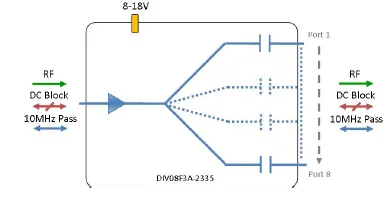
The ELT Systems Active Splitter distributes an RF signal evenly across multiple outputs while holding signal strength and quality, making it a core building block in VSAT distribution racks. Models cover L-band and IF-band in 2-way, 3-way, 4-way, 8-way and 16-way configurations, with DC block or single-port DC pass and 10 MHz reference pass depending on part number. Because it is an active design, the ELT Systems Active Splitter delivers minimal signal loss across its outputs, suiting commercial and military satellite networks where many receivers share one feed.
Key Features
- Even RF distribution across outputs while maintaining signal strength and quality
- Available in 2-way, 3-way, 4-way, 8-way and 16-way configurations
- L-band and IF-band model families to match your distribution plan
- DC block versions protect upstream equipment from downstream supply voltage
- Selected models pass DC on one port plus a 10 MHz reference
- Minimal signal loss suits both commercial and military satellite networks
- Durable build for dependable service in challenging operating environments
Technical Specifications
Typical Applications
- Teleport and gateway racks feeding many receivers from one downlink chain
- Maritime and cruise VSAT systems distributing L-band to multiple modems
- Broadcast and SNG monitoring positions sharing a single satellite feed
- Government and defence signal monitoring and multi-receiver installations
- Enterprise backhaul and hub sites with redundant demodulator pools
- Test, integration and acceptance benches driving several analysers at once
How an Active L-Band Splitter Works in a VSAT Distribution Rack
A passive divider shares one input among several outputs, and the physics of that division costs level at every port: the more ways you split, the less each receiver sees. An active splitter compensates for that division so the outputs stay usable, which is what lets a 16-way distribution network exist at all without a chain of separate amplifiers. In a VSAT rack the splitter usually sits after the LNB feed or after a downconverter, fanning a single satellite feed out to modems, demodulators, spectrum analysers and monitoring receivers. The ELT Systems Active Splitter is designed for exactly this position, distributing signals evenly with minimal loss across L-band and IF-band models so every branch of the network receives a signal of comparable quality.
Choosing the Right Way Count and Band
Start with the number of destinations you have today, then add headroom for the ones you will add later, because retrofitting a larger splitter into a live rack is far more disruptive than specifying it up front. ELT Systems covers 2-way, 3-way, 4-way, 8-way and 16-way configurations, so most distribution plans map onto a single unit rather than a cascade. Band selection follows your architecture: L-band models such as DIV02L1A-2301, DIV04L1A-2370 and DIV16L1A-2439 suit outputs taken straight from an LNB feed, while IF-band models such as DIV03F1A-2403 and DIV08F3A-2335 sit in chains built around a conventional intermediate frequency. Whichever family suits your architecture, confirm the rated frequency range and port count on the datasheet for the exact model before you commit to it.
DC Block, DC Pass and 10 MHz Reference Routing
In most distribution networks only one path should carry DC to the outdoor unit, and every other path must be blocked so supplies do not collide and so sensitive receivers never see voltage on their inputs. The ELT Systems Active Splitter range is built around that discipline. DC block models isolate every port, while models described as one-port DC plus 10 MHz pass, including DIV04L1A-2370 and DIV16L1A-2439, allow a single designated port to carry supply and reference through to the LNB while the remaining outputs stay clean. Decide early which port owns the DC feed, label it clearly in the rack, and document it, because an undocumented powered port is one of the most common causes of confusing faults during later maintenance.
Why Source ELT Systems Active Splitters From GCCSAT in the UAE
GCCSAT supplies ELT Systems RF distribution products across the UAE, the GCC and the wider Middle East to teleports, maritime operators, broadcasters, integrators and government users. Splitters are rarely bought in isolation: they sit between LNBs, amplifiers, bias tees, combiners and modems, and the right choice depends on the whole distribution plan. We review that plan with you, advise on way count, band and DC routing, and support integration and commissioning once the equipment is on site. Our regional presence covers sourcing and logistics into the region, and we can support repeat supply for networks already in service. Share your rack layout and output count and we will confirm the right ELT Systems Active Splitter model and quote on request.
Frequently Asked Questions
What split configurations does the ELT Systems Active Splitter offer?
The published range covers 2-way, 3-way, 4-way, 8-way and 16-way models. IF-band versions include the 3-way DIV03F1A-2403 and 8-way DIV08F3A-2335, while L-band versions include the 2-way DIV02L1A-2301, 4-way DIV04L1A-2370 and 16-way DIV16L1A-2439. Choose the way count that covers your current outputs plus planned expansion.
What is the difference between an active splitter and a passive splitter?
A passive splitter divides the input signal among its outputs, so each port receives a lower level as the way count increases. An active splitter includes electronics that compensate for that division, keeping output levels usable across many ports. Active designs need a power feed and add their own noise contribution, but they make high way-count distribution practical without extra amplifier stages.
Which port carries DC on the L-band active splitter models?
On the models described as one-port DC plus 10 MHz pass, such as DIV04L1A-2370 and DIV16L1A-2439, a single designated port carries DC and the 10 MHz reference through to the outdoor unit, while the remaining outputs are blocked. The datasheet for your specific part number identifies that port, so check it before wiring and label the port in the rack.
Does the ELT Systems Active Splitter pass a 10 MHz reference?
Selected models do. Several part numbers in the range are specified with 10 MHz pass alongside their DC arrangement, which matters when an outdoor unit relies on an indoor reference for frequency stability. Other models are pure DC block designs. Confirm the 10 MHz behaviour on the datasheet for the exact model rather than assuming it applies to the whole family.
Can GCCSAT supply and integrate ELT Systems splitters in the Middle East?
Yes. GCCSAT supplies ELT Systems RF components including the active splitter range throughout the UAE, the GCC and the wider Middle East, and can assist with integration and commissioning into new or existing VSAT distribution racks. Send us your required way count, band and DC routing needs and we will confirm the model that suits your rack.
Enquire About ELT Systems L-Band and IF-Band Active Splitter (2 to 16-Way)
Our sales team will provide pricing, availability, and shipping details.
Request a QuoteWhatsAppMore VSAT RF Components
- XMW BPF-1219-400 L-Band Bandpass Filter
- XMW BPF-3423-36 C-Band Bandpass Filter
- XMW BPF-1000-30 L-Band Bandpass Filter
- XMW BPF-CX-CF-BW C-Band Bandpass Filter Series
- XMW BPF-CF-BW (BPF-C-1 to BPF-C-6) C-Band Bandpass Filters
- XMW BPF-7500-500 X-Band Bandpass Filter
- XMW BPF-11600-1800 Ku-Band Bandpass Filter
- Times Microwave N-Type and F-Type Coaxial Connectors
- Times Microwave LMR400, LMR600, RG6 and RG11 Coaxial Cables
- Norsat OMT-KUE Ku-Band Extended OMT Transmit Reject Filter
- Norsat C-Band Band Pass Filter (BPF)
- Nexgenwave Low Ku-Band Waveguide Rejection Filter
- Jupiter Microwave Flexible Waveguide (C-Band and Ku-Band)
- ELT Systems Passive Combiner-Splitter (L-Band and S-Band)
- ELT Systems TEEL1-4007 Bias Tee
- ELT Systems XX-435000 RF Attenuator (3, 6, 10 and 20 dB)
- ELT Systems L-Band Active Combiner (2, 4, 8 and 16-Way)
- Actox Bias-T DC Power Injector (ABT6AN, ABT6AON, ABT6ARS)
Product Categories
- VSAT BUC
- VSAT LNB
- VSAT Antennas
- VSAT Fixed Antennas
- VSAT Flyaway Antennas
- VSAT Maritime Antennas
- VSAT KingSat Antennas
- L-Band Satellite Terminals
- Cobham BGAN Terminals
- Thuraya L-Band Terminals
- VSAT Satellite Modems
- Satellite Phones
- Teltonika Products
- Sangfor Firewall & SD-WAN
- Thuraya Accessories
- Excelerate Hybrid Connectivity
- Peplink Products
- VSAT RF Components
- VSAT Hub & Test Equipment
- Remote Site Power Systems