
- Home
- Industries
Industries
Enabling transformation and progress across a wide range of industries globally, fostering innovation and growth in every sector.
Explore all → - Solutions
Connectivity
Connecting industries worldwide with reliable satellite internet solutions, driving innovation, efficiency, and growth across all sectors globally.
Explore all → - Services
Professional VSAT & IT Services
Delivering expert VSAT and IT solutions for seamless connectivity, reliability, and performance across all sectors.
Explore all → - Products
Superior Connectivity, Trusted Solutions
Offering premium Satcom products that guarantee reliable connectivity and boost innovation across industries.
Explore all → - Coverage
WorldWide Coverage
Delivering tailored satellite services that enhance connectivity, foster innovation, and support growth in every industry.
Explore all → - About
- Blog
- Contact
Nisshinbo NJR2841 Universal Ku-Band 2LO PLL LNB
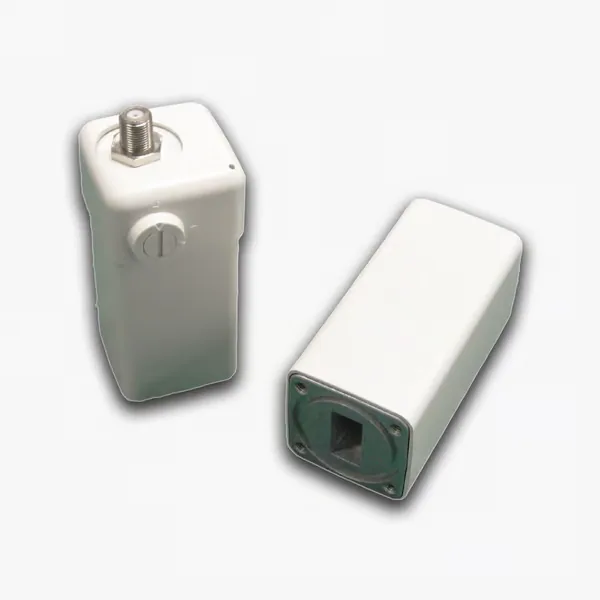
Nisshinbo NJR2841 Universal Ku-Band 2LO PLL LNB
The Nisshinbo NJR2841 is a universal Ku-band 2LO PLL LNB covering 10.7 to 12.75 GHz through two local oscillators, 9.75 GHz for the low band and 10.6 GHz for the high band. A mechanical switch on the unit sets which oscillator is active, making the NJR2841 a straightforward choice for fixed installations where the band is decided at commissioning. Noise figure is 0.8 dB typical, and F-type or N-type versions weigh 210 g and 240 g respectively for VSAT, teleport and broadcast receive chains.
Key Features
- Covers the full 10.7 to 12.75 GHz Ku-band receive spectrum across two local oscillators
- Mechanical switch sets the LO, so no tone-capable modem or receiver is required
- PLL design with internal reference stability of ±50 ppm on the L-type variant
- 0.8 dB typical noise figure keeps system noise temperature low for tight link budgets
- Small, light housing at 210 g F-type and 240 g N-type for easy feed mounting
- Available with F-type or N-type output connector to suit site cabling standards
- RoHS compliant, part of the established Nisshinbo R2841 LNB series
Technical Specifications
Typical Applications
- Fixed Ku-band VSAT remote terminals
- Teleport, hub and gateway receive systems
- Broadcast headend and cable feed reception
- Oil, gas and offshore platform communications
- Mining and remote camp connectivity sites
- Government and enterprise fixed earth stations
How the NJR2841 Ku-Band LNB Fits Into a Receive Chain
Every satellite receive chain starts with an LNB, and its noise figure sets the floor for everything downstream. The NJR2841 amplifies the incoming Ku-band signal at the antenna feed and converts it to L-band so a single coaxial run can carry it to the modem or receiver indoors. Two local oscillators split the work. The 9.75 GHz oscillator translates 10.7 to 11.7 GHz down to 950 to 1,950 MHz, while the 10.6 GHz oscillator translates 11.7 to 12.75 GHz down to 1,100 to 2,150 MHz. Between them the NJR2841 reaches every Ku-band downlink sub-band in common commercial use, which means one part number can be stocked for terminals pointed at different satellites and different transponder plans.
Mechanical Switch or Tone Control: Choosing Your LO Selection Method
The NJR2841 selects its local oscillator with a mechanical switch on the unit itself. An installer sets the band once during commissioning and it stays there until someone changes it deliberately. That predictability is an advantage in fixed installations: there is no dependency on the modem generating a 22 kHz tone, no risk of a line amplifier or IF distribution component blocking that tone, and no chance of an unintended band change from a configuration error indoors. The trade-off is access. If your operation expects to move between Ku-band sub-bands remotely, or the antenna is on a mast, tower or offshore structure that is costly to reach, the tone-switched NJR2842 from the same series is the better fit.
Commissioning and Cabling Notes for the NJR2841
Set the mechanical switch to the correct band before the LNB goes onto the feed, and record the setting in the site documentation so a later engineer is not left guessing why a carrier will not lock. Choose the connector variant to match your infrastructure, F-type at 210 g or N-type at 240 g. The IF coaxial run carries the L-band signal indoors and the DC supply outdoors, so keep loss within the modem's budget, use quality connectors and weatherproof the outdoor termination thoroughly against humidity, salt air and Gulf temperature swings. For narrow or low symbol rate carriers, compare the ±50 ppm internal reference stability of the L-type variant against your demodulator's acquisition and tracking range.
Sourcing Nisshinbo Ku-Band LNBs in the UAE and Wider GCC
GCCSAT is a UAE-based satellite communications integrator supplying ground segment hardware across the Emirates, the GCC and the broader Middle East. The NJR2841 sits alongside the tone-switched NJR2842 in the Ku-band receive equipment we support, and our engineers can help you decide which selection method, connector type and stability grade actually suits your terminal design. Beyond supply, we support antenna and feed integration, IF cabling design, commissioning and ongoing technical assistance for VSAT networks in the region. Datasheets for the R2841 series are available for design review, and pricing and availability for the NJR2841 are quoted on request once we understand your configuration and quantity.
Frequently Asked Questions
What frequency range does the Nisshinbo NJR2841 cover?
The NJR2841 covers 10.7 to 11.7 GHz in the low band and 11.7 to 12.75 GHz in the high band. Low band converts to 950 to 1,950 MHz through a 9.75 GHz local oscillator, and high band converts to 1,100 to 2,150 MHz through a 10.6 GHz local oscillator, together covering the standard Ku-band receive spectrum.
How is the local oscillator selected on the NJR2841?
By mechanical switch on the LNB itself. The installer selects the low band or high band oscillator physically during installation, which means the NJR2841 does not depend on the modem or receiver producing a 22 kHz control tone. It is well suited to fixed terminals where the operating band is fixed at commissioning.
Should I choose the NJR2841 or the NJR2842?
Choose the NJR2841 when the band is set once and the antenna is easy to reach, or when your indoor equipment cannot generate a 22 kHz tone. Choose the NJR2842 when you need to change bands remotely. Both share the same published frequency plan, 0.8 dB typical noise figure and R2841 series design.
What is a 2LO PLL LNB?
A 2LO LNB has two local oscillators instead of one, letting a single unit downconvert two different RF sub-bands to L-band. PLL means the oscillators are phase-locked rather than free running, which gives far better frequency stability than older dielectric resonator designs. The NJR2841 uses 9.75 GHz and 10.6 GHz oscillators.
Can GCCSAT support installation of the NJR2841 in the UAE?
Yes. GCCSAT supplies and supports Ku-band LNBs throughout the UAE, GCC and Middle East, including feed integration, IF cabling guidance, terminal commissioning and after-sales technical support. Tell us the antenna, feed interface and modem you are using and we will confirm the right NJR2841 variant and quote it on request.
Enquire About Nisshinbo NJR2841 Universal Ku-Band 2LO PLL LNB
Our sales team will provide pricing, availability, and shipping details.
Request a QuoteWhatsAppMore VSAT LNB
- iDirect Universal LNB
- NJRC NJR2842A1 Universal PLL LNB Ku-Band
- NJRC NJR2843S Universal PLL LNB Ku-Band
- NJRC NJS8486H PLL LNB C-Band
- NJRC NJS8487H PLL LNB C-Band
- Norsat 3120 PLL LNB C-Band
- Norsat 3220 PLL LNB C-Band
- Swedish Microwave Single Band PLL LNB Ku-Band
- XMW R3000I Series C-Band INT LNB
- XMW R3000AE C-Band Auto Reference LNB
- Nisshinbo NJS8498E Series INSAT C-Band PLL LNB
- Nisshinbo NJS8497E Series Standard C-Band PLL LNB
- Nisshinbo NJS8496E Series Full C-Band PLL LNB
- Nisshinbo NJTR2845 / NJR2845 Series Ku-Band PLL LNB
- Nisshinbo NJR2843 Universal Ku-Band 2LO PLL LNB
- Nisshinbo NJR2842 Universal Ku-Band 2LO PLL LNB
- Norsat Ka-Band LNB 7000 Series
- Norsat C-Band LNB 3000-BPF and 3000-sBPF
- Norsat Ku-Band LNB (HS1000, 1000X-2, 1000 XH, 1000H-2, 15000L)
- ST Engineering iDirect Universal Ku-Band PLL LNB
Product Categories
- VSAT BUC
- VSAT LNB
- VSAT Antennas
- VSAT Fixed Antennas
- VSAT Flyaway Antennas
- VSAT Maritime Antennas
- VSAT KingSat Antennas
- L-Band Satellite Terminals
- Cobham BGAN Terminals
- Thuraya L-Band Terminals
- VSAT Satellite Modems
- Satellite Phones
- Teltonika Products
- Sangfor Firewall & SD-WAN
- Thuraya Accessories
- Excelerate Hybrid Connectivity
- Peplink Products
- VSAT RF Components
- VSAT Hub & Test Equipment
- Remote Site Power Systems