
- Home
- Industries
Industries
Enabling transformation and progress across a wide range of industries globally, fostering innovation and growth in every sector.
Explore all → - Solutions
Connectivity
Connecting industries worldwide with reliable satellite internet solutions, driving innovation, efficiency, and growth across all sectors globally.
Explore all → - Services
Professional VSAT & IT Services
Delivering expert VSAT and IT solutions for seamless connectivity, reliability, and performance across all sectors.
Explore all → - Products
Superior Connectivity, Trusted Solutions
Offering premium Satcom products that guarantee reliable connectivity and boost innovation across industries.
Explore all → - Coverage
WorldWide Coverage
Delivering tailored satellite services that enhance connectivity, foster innovation, and support growth in every industry.
Explore all → - About
- Blog
- Contact
XMW R3000AE C-Band Auto Reference LNB
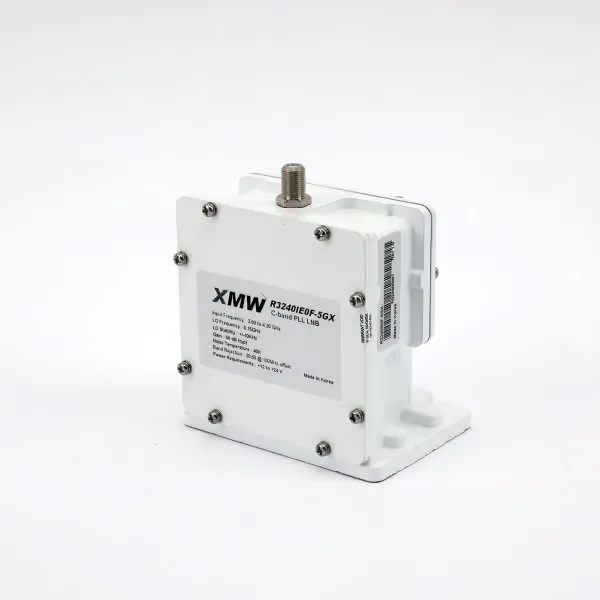
XMW R3000AE C-Band Auto Reference LNB
The XMW Model R3000AE is a C-band Auto Reference LNB for earth-station and VSAT receive chains. It converts a 3.70-4.20 GHz input band using a 5.15 GHz local oscillator, and is specified at 62 dB gain, 30 K noise temperature and -78 dBc phase noise at 1 kHz. Its LO stability is auto switchable, with a reference figure of ±10 kHz, making the R3000AE a practical choice where a site may or may not have a stable reference available at the antenna. Other frequency bands are available on request.
Key Features
- Auto switchable LO stability arrangement with a reference figure of ±10 kHz
- Covers the 3.70-4.20 GHz C-band downlink with a 5.15 GHz local oscillator
- 62 dB gain supports long IF runs and passive distribution to multiple modems
- 30 K noise temperature keeps the first-stage contribution to system G/T low
- Phase noise of -78 dBc at 1 kHz supports narrowband and closed-network carriers
- Other frequency bands available on request for non-standard receive plans
Technical Specifications
Typical Applications
- Fixed C-band earth stations and satellite teleports
- Maritime and offshore oil and gas VSAT terminals
- Broadcast contribution and occasional-use SNG links
- Cellular backhaul and enterprise trunking over C-band
- Government, public safety and disaster-recovery terminals
- Remote mining and pipeline monitoring sites
What an Auto Reference C-Band LNB Does in an Earth Station
In a conventional VSAT terminal the LNB generates its own local oscillator from an internal source, and the accuracy of that source sets how far a received carrier can drift from where the demodulator expects it. In more demanding networks the LNB is instead disciplined by a stable reference distributed from the indoor equipment, so that every outdoor unit on the site shares a common frequency origin. Auto reference designs such as the R3000AE are built around switching between those modes rather than committing to one. The published stability for the R3000AE is auto switchable with a reference of ±10 kHz. Because reference handling differs between manufacturers and product families, confirm the exact reference frequency, level and switching behaviour on the R3000AE datasheet before you finalise the IF and reference distribution design.
R3000AE Performance: Gain, Noise Temperature and Phase Noise
Three published figures describe most of what an integrator needs from this class of C-band LNB. Noise temperature of 30 K sets the contribution of the first active stage to the overall system G/T, and because it comes first in the chain it carries disproportionate weight in the link budget. Gain of 62 dB determines how much coaxial and splitter loss the receive path can absorb before the modem input level falls out of range, which in turn decides how far the antenna can sit from the equipment room. Phase noise of -78 dBc at 1 kHz describes the short-term spectral purity of the conversion. That figure becomes important on narrowband carriers and higher-order modulation, where phase noise translates directly into degraded MER and reduced margin at the demodulator.
Integrating the R3000AE Into a C-Band Antenna System
Start by confirming the mechanical interface. C-band LNBs attach to the feed or OMT through a defined flange, and the polarisation orientation is set during commissioning against the satellite operator's cross-pol test. Electrically, plan the IF cable type and length against the 62 dB of available gain, allowing for splitters, surge arrestors and any L-band matrix in the path. Power is normally injected over the same coaxial cable from the modem or an external inserter, so verify that DC is present at the LNB port before troubleshooting anything further upstream. Outdoors, weatherproof the connector properly, add a drip loop, and ground the outdoor unit. In the Gulf, wind-blown dust and high daytime temperatures make good sealing and shading of cable entries a practical reliability measure rather than an optional refinement.
Buying XMW Auto Reference LNBs from GCCSAT in the UAE
GCCSAT is a UAE-based satellite communications integrator supplying LNBs, BUCs, antennas and terminal electronics across the GCC, the wider Middle East and Africa. We can supply the XMW R3000AE C-band Auto Reference LNB alongside the feed, reference distribution, powering and cabling parts needed to complete a receive chain, so that a project arrives as a working system rather than a box of components. Our team can review your carrier plan and link budget, advise on whether an auto reference or fixed-stability LNB is the better fit, and support installation and commissioning on site. XMW offers other frequency bands on request. Pricing for the R3000AE is quoted on request; send us the quantity, the destination and the antenna it will mount on, and we will prepare a quotation.
Frequently Asked Questions
What frequency range does the XMW R3000AE C-band LNB cover?
The R3000AE is specified with an input frequency range of 3.70-4.20 GHz and a local oscillator frequency of 5.15 GHz, converting the standard C-band downlink into the L-band IF used by satellite modems and receivers. XMW states that other frequency bands are available on request, so if your network operates on a different C-band segment, send us the required range and we will confirm availability.
What does auto reference mean on the R3000AE LNB?
The published LO stability for the R3000AE is described as auto switchable, with a reference figure of ±10 kHz. Auto reference LNBs are generally intended for installations where a disciplining reference may or may not be present at the outdoor unit. The exact reference frequency, level and switching behaviour are defined on the product datasheet, so review that document against your indoor equipment before finalising the design.
What noise temperature and gain does the R3000AE offer?
Noise temperature is specified at 30 K and gain at 62 dB. Together these determine how much the LNB contributes to system G/T and how much cable and splitter loss the receive chain can tolerate. Phase noise is published as -78 dBc at 1 kHz, which is the figure to check when the network carries narrowband SCPC traffic or uses higher-order modulation schemes.
Can GCCSAT deliver the R3000AE to offshore and remote sites?
Yes. GCCSAT regularly supplies satellite hardware to offshore platforms, vessels, remote camps and government sites across the UAE, the GCC and neighbouring regions through established logistics partners. Provide the delivery point, quantity and any customs or documentation requirements with your enquiry and we will confirm the arrangements and issue a formal quotation for the R3000AE.
Why is C-band still used when Ku-band antennas are smaller?
C-band is significantly more resistant to rain fade than Ku-band, so it remains the preferred band for tropical and monsoon regions, ocean routes and services that must hold availability targets through heavy weather. It also has a long history of stable, widely available space segment. The trade-off is a physically larger antenna for the same gain, which is why C-band dominates fixed and maritime installations rather than compact portable terminals.
Enquire About XMW R3000AE C-Band Auto Reference LNB
Our sales team will provide pricing, availability, and shipping details.
Request a QuoteWhatsAppMore VSAT LNB
- iDirect Universal LNB
- NJRC NJR2842A1 Universal PLL LNB Ku-Band
- NJRC NJR2843S Universal PLL LNB Ku-Band
- NJRC NJS8486H PLL LNB C-Band
- NJRC NJS8487H PLL LNB C-Band
- Norsat 3120 PLL LNB C-Band
- Norsat 3220 PLL LNB C-Band
- Swedish Microwave Single Band PLL LNB Ku-Band
- XMW R3000I Series C-Band INT LNB
- Nisshinbo NJS8498E Series INSAT C-Band PLL LNB
- Nisshinbo NJS8497E Series Standard C-Band PLL LNB
- Nisshinbo NJS8496E Series Full C-Band PLL LNB
- Nisshinbo NJTR2845 / NJR2845 Series Ku-Band PLL LNB
- Nisshinbo NJR2843 Universal Ku-Band 2LO PLL LNB
- Nisshinbo NJR2842 Universal Ku-Band 2LO PLL LNB
- Nisshinbo NJR2841 Universal Ku-Band 2LO PLL LNB
- Norsat Ka-Band LNB 7000 Series
- Norsat C-Band LNB 3000-BPF and 3000-sBPF
- Norsat Ku-Band LNB (HS1000, 1000X-2, 1000 XH, 1000H-2, 15000L)
- ST Engineering iDirect Universal Ku-Band PLL LNB
Product Categories
- VSAT BUC
- VSAT LNB
- VSAT Antennas
- VSAT Fixed Antennas
- VSAT Flyaway Antennas
- VSAT Maritime Antennas
- VSAT KingSat Antennas
- L-Band Satellite Terminals
- Cobham BGAN Terminals
- Thuraya L-Band Terminals
- VSAT Satellite Modems
- Satellite Phones
- Teltonika Products
- Sangfor Firewall & SD-WAN
- Thuraya Accessories
- Excelerate Hybrid Connectivity
- Peplink Products
- VSAT RF Components
- VSAT Hub & Test Equipment
- Remote Site Power Systems