
- Home
- Industries
Industries
Enabling transformation and progress across a wide range of industries globally, fostering innovation and growth in every sector.
Explore all → - Solutions
Connectivity
Connecting industries worldwide with reliable satellite internet solutions, driving innovation, efficiency, and growth across all sectors globally.
Explore all → - Services
Professional VSAT & IT Services
Delivering expert VSAT and IT solutions for seamless connectivity, reliability, and performance across all sectors.
Explore all → - Products
Superior Connectivity, Trusted Solutions
Offering premium Satcom products that guarantee reliable connectivity and boost innovation across industries.
Explore all → - Coverage
WorldWide Coverage
Delivering tailored satellite services that enhance connectivity, foster innovation, and support growth in every industry.
Explore all → - About
- Blog
- Contact
XMW R3000I Series C-Band INT LNB
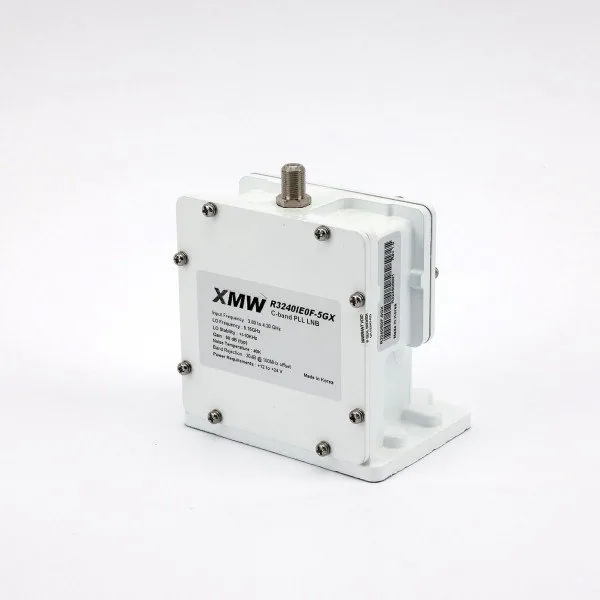
XMW R3000I Series C-Band INT LNB
The XMW C-band INT LNB is a low-noise block downconverter for C-band satellite receive chains, offered under four part numbers: R3000IA, R3000IB, R3000IC and R3000ID. It covers an input frequency range of 3.70-4.20 GHz using a 5.15 GHz local oscillator, and delivers 62 dB of gain with a 30 K noise temperature and -78 dBc phase noise at 1 kHz. The four R3000I variants differ in LO stability, letting integrators match the LNB to the carrier plan of a teleport, VSAT hub or remote earth station. Other frequency bands are available on request.
Key Features
- Covers the 3.70-4.20 GHz C-band downlink with a 5.15 GHz local oscillator
- 62 dB gain supports long IF cable runs between the antenna and indoor equipment
- 30 K noise temperature helps preserve system G/T on small and mid-size antennas
- Four part numbers give LO stability grades of ±5 kHz, ±10 kHz and ±25 kHz
- R3000ID is listed across ±5/±10/±25 kHz for flexible deployment planning
- Phase noise of -78 dBc at 1 kHz suits narrowband SCPC and MCPC carrier types
- Other frequency bands available on request for non-standard receive segments
Technical Specifications
Typical Applications
- Teleport and gateway C-band receive chains
- Maritime and offshore energy VSAT terminals
- Broadcast contribution, DSNG and satellite news gathering
- Enterprise and cellular backhaul over C-band space segment
- Government, defence and disaster-recovery earth stations
- Mining and remote-site connectivity in high-rainfall regions
How the R3000I C-Band LNB Fits Into a VSAT Receive Chain
An LNB sits at the focal point of the antenna, immediately behind the feed, and does two jobs at once. It amplifies an extremely weak downlink signal while adding as little noise of its own as possible, then converts that signal to an L-band IF that ordinary coaxial cable can carry indoors. In the R3000I, the conversion uses a 5.15 GHz local oscillator applied to a 3.70-4.20 GHz input band. Because the LNB is the first active stage in the chain, its 30 K noise temperature weighs on the system G/T budget far more heavily than anything downstream. The 62 dB of gain that follows is what allows the converted signal to survive a long cable run to the modem, splitter network or L-band matrix without an in-line amplifier in most installations.
Choosing the Right LO Stability Grade for Your C-Band Carriers
The four R3000I part numbers differ in local oscillator stability rather than in gain or noise performance. R3000IA is specified at ±5 kHz, R3000IB at ±10 kHz, R3000IC at ±25 kHz, and R3000ID is listed across ±5/±10/±25 kHz. Stability matters because any drift in the LO appears directly as a frequency offset at the modem input. Wideband DVB-S2 video carriers tolerate a comparatively loose figure. Narrowband SCPC data links, low-symbol-rate telemetry and carrier-in-carrier schemes need the tightest grade that the demodulator acquisition range and the network design justify. When specifying an R3000I, work backwards from the smallest symbol rate you expect to carry and the acquisition window of the demodulator, then choose the part number that keeps the worst-case offset comfortably inside it.
Installation and Integration Notes for C-Band LNBs
C-band LNBs are normally powered over the same coaxial cable that carries the L-band IF, so the modem or a separate power inserter has to be configured to supply DC before the receive chain will work at all. A silent receiver is very often a powering or connector fault rather than a failed LNB. Weatherproofing matters as much in the Gulf as in the tropics: seal the RF connector with self-amalgamating tape, dress the cable with a drip loop, and keep the feed boot intact so that dust and moisture cannot track into the waveguide. Mechanically, confirm the flange and feed interface against your antenna and OMT before ordering, and verify polarisation orientation during commissioning. Correct grounding of the outdoor unit protects both the LNB and the indoor equipment during surge events.
Why Buy XMW C-Band LNBs from GCCSAT in the UAE
GCCSAT supplies XMW C-band LNBs, including the R3000I series, to integrators, teleports, broadcasters and offshore operators across the UAE, the wider GCC and the Middle East. Working with a regional supplier shortens the loop between specifying a part and getting it onto an antenna. We help you match the LO stability grade to your carrier plan, confirm the feed and connector interface, and specify the reference, powering and cabling elements so that the receive chain is complete when it arrives. Our engineers support installation, pointing and commissioning, and can advise on a spares strategy for sites where an antenna visit is hard to arrange. XMW also offers other frequency bands on request. Pricing for the R3000I series is quoted on request; send us your configuration and application and we will respond with a formal quotation.
Frequently Asked Questions
What frequency range does the XMW R3000I C-band LNB cover?
The R3000I series is specified with an input frequency range of 3.70-4.20 GHz and a local oscillator frequency of 5.15 GHz, which translates the standard C-band downlink into the L-band IF used by satellite modems and receivers. XMW states that other frequency bands are available on request, so tell us the exact sub-band you need to receive and we will confirm what can be supplied.
What is the difference between the R3000IA, R3000IB, R3000IC and R3000ID?
All four share the same 3.70-4.20 GHz input band, 5.15 GHz LO, 62 dB gain and 30 K noise temperature. The published difference is local oscillator stability: ±5 kHz for R3000IA, ±10 kHz for R3000IB, ±25 kHz for R3000IC, and ±5/±10/±25 kHz listed for R3000ID. Narrowband SCPC carriers generally justify the tighter grades, while wideband video carriers are more tolerant of LO drift.
How much gain does the R3000I LNB provide, and why does gain matter?
Gain is specified at 62 dB. In practice, LNB gain determines how much coaxial and splitter loss the receive chain can absorb between the antenna and the modem before the level at the demodulator falls below its working window. Higher gain allows longer cable runs and passive splitting to several receivers, but the level presented to each modem still has to be checked against that modem's specified input range.
Does GCCSAT supply the XMW R3000I outside the UAE?
Yes. GCCSAT is based in the UAE and supplies satellite communications hardware across the GCC, the wider Middle East and Africa, including offshore and remote locations reached through our regional logistics partners. Tell us the delivery point, the quantity and any documentation you need for import, and we will confirm the arrangements and issue a quotation for the R3000I configuration you require.
Should I choose a C-band LNB or a Ku-band LNB for my site?
It depends on the space segment you are buying and on the local climate. C-band suffers far less rain fade than Ku-band, which is why it remains the standard for tropical and equatorial regions, long maritime routes and high-availability government and broadcast links. Ku-band delivers more gain from a smaller dish. If your capacity is on a C-band transponder, the R3000I belongs in that receive chain.
Enquire About XMW R3000I Series C-Band INT LNB
Our sales team will provide pricing, availability, and shipping details.
Request a QuoteWhatsAppMore VSAT LNB
- iDirect Universal LNB
- NJRC NJR2842A1 Universal PLL LNB Ku-Band
- NJRC NJR2843S Universal PLL LNB Ku-Band
- NJRC NJS8486H PLL LNB C-Band
- NJRC NJS8487H PLL LNB C-Band
- Norsat 3120 PLL LNB C-Band
- Norsat 3220 PLL LNB C-Band
- Swedish Microwave Single Band PLL LNB Ku-Band
- XMW R3000AE C-Band Auto Reference LNB
- Nisshinbo NJS8498E Series INSAT C-Band PLL LNB
- Nisshinbo NJS8497E Series Standard C-Band PLL LNB
- Nisshinbo NJS8496E Series Full C-Band PLL LNB
- Nisshinbo NJTR2845 / NJR2845 Series Ku-Band PLL LNB
- Nisshinbo NJR2843 Universal Ku-Band 2LO PLL LNB
- Nisshinbo NJR2842 Universal Ku-Band 2LO PLL LNB
- Nisshinbo NJR2841 Universal Ku-Band 2LO PLL LNB
- Norsat Ka-Band LNB 7000 Series
- Norsat C-Band LNB 3000-BPF and 3000-sBPF
- Norsat Ku-Band LNB (HS1000, 1000X-2, 1000 XH, 1000H-2, 15000L)
- ST Engineering iDirect Universal Ku-Band PLL LNB
Product Categories
- VSAT BUC
- VSAT LNB
- VSAT Antennas
- VSAT Fixed Antennas
- VSAT Flyaway Antennas
- VSAT Maritime Antennas
- VSAT KingSat Antennas
- L-Band Satellite Terminals
- Cobham BGAN Terminals
- Thuraya L-Band Terminals
- VSAT Satellite Modems
- Satellite Phones
- Teltonika Products
- Sangfor Firewall & SD-WAN
- Thuraya Accessories
- Excelerate Hybrid Connectivity
- Peplink Products
- VSAT RF Components
- VSAT Hub & Test Equipment
- Remote Site Power Systems