
- Home
- Industries
Industries
Enabling transformation and progress across a wide range of industries globally, fostering innovation and growth in every sector.
Explore all → - Solutions
Connectivity
Connecting industries worldwide with reliable satellite internet solutions, driving innovation, efficiency, and growth across all sectors globally.
Explore all → - Services
Professional VSAT & IT Services
Delivering expert VSAT and IT solutions for seamless connectivity, reliability, and performance across all sectors.
Explore all → - Products
Superior Connectivity, Trusted Solutions
Offering premium Satcom products that guarantee reliable connectivity and boost innovation across industries.
Explore all → - Coverage
WorldWide Coverage
Delivering tailored satellite services that enhance connectivity, foster innovation, and support growth in every industry.
Explore all → - About
- Blog
- Contact
Comtech CDM-780 Advanced Satellite Modem
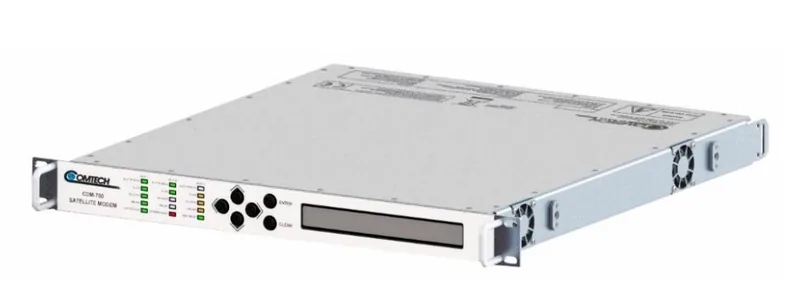
Comtech CDM-780 Advanced Satellite Modem
The Comtech CDM-780 Advanced Satellite Modem is a high-speed trunking and broadcast platform aimed at teleports and backbone links that need maximum efficiency per megahertz. Its modular design lets the CDM-780 be configured as a modem, a modulator, or two demodulators, so a single chassis can be adapted to different network roles. Extended symbol and data rates build on Comtech's high-speed trunking heritage, while support for HTS and GEO operation, with MEO and LEO as future capability, plus antenna and satellite handover, keeps links stable in dynamic constellations.
Key Features
- Modular design configurable as a modem, modulator, or two demodulators.
- Extended symbol and data rates extend Comtech's high-speed trunking modem legacy.
- Supports High Throughput Satellite and GEO mode operation for diverse networks.
- MEO and LEO mode operation listed by Comtech as future capability.
- Antenna and satellite handover keeps communication uninterrupted in dynamic satellite environments.
- Single platform adapts to changing network roles without replacing the chassis.
- Aimed at operators seeking the highest throughput and efficiency per carrier.
Technical Specifications
Typical Applications
- Teleport and gateway trunking links
- Satellite broadcast and content distribution
- Cellular and mobile network backhaul over satellite
- HTS gateway and forward-link infrastructure
- Government and defence backbone communications
- Carrier-grade point-to-point capacity between earth stations
What a High-Speed Trunking and Broadcast Satellite Modem Does
Trunking modems live at the heavy end of satellite communications. Rather than serving a single remote office, they carry aggregated traffic between teleports, feed broadcast distribution networks, or backhaul entire cellular sites over a single high-capacity carrier. At that scale, every fraction of a decibel and every percentage point of spectral efficiency translates into transponder cost, which is why the CDM-780 is positioned around efficiency and throughput rather than feature breadth. The economics are simple: a trunking link that runs even slightly more efficiently pays back its equipment cost quickly over a multi-year space segment contract. That is the calculation procurement engineers are really making when they compare platforms in this class.
Modular Configuration and Satellite Compatibility of the CDM-780
The CDM-780 can be configured as a modem, as a modulator, or as two demodulators. That flexibility matters because trunking and broadcast networks are rarely symmetrical. A broadcast head end may need modulation capacity only; a receive site may need demodulation density; a bidirectional trunk needs both. One chassis type covering all three roles reduces the number of distinct products an operator has to buy, stock and learn. On the space side, Comtech designed the CDM-780 to support High Throughput Satellite and Geostationary Earth Orbit operation, with Medium Earth Orbit and Low Earth Orbit listed as future capability. Antenna and satellite handover support means links can move between assets without dropping the service, which is essential as non-geostationary constellations enter mainstream commercial use.
Installation and Integration Notes
A CDM-780 deployment is an earth station project rather than a simple modem install. Plan rack layout, redundancy strategy and monitoring integration alongside the RF chain from the outset. Confirm that the high power amplifier, upconverter and antenna can actually support the carrier plan you intend to run, and that the receive chain has the required stability. Provide conditioned power and sufficient cooling for continuous full-rate operation, and ensure the terrestrial interface side of the link, including switching and routing capacity, can absorb the throughput the satellite side delivers. Where the network will use antenna or satellite handover, test those transitions during commissioning rather than discovering their behaviour during a live service event.
Why Buy the Comtech CDM-780 from GCCSAT in the UAE
GCCSAT supplies Comtech trunking and broadcast modems, including the CDM-780 Advanced Satellite Modem, to teleport operators, broadcasters, integrators and government users across the UAE, the GCC and the wider Middle East. Projects at this scale need more than a shipped box, so we support carrier planning discussions, help align the modem configuration with the RF chain and terrestrial interfaces, and assist with integration and commissioning at the earth station. Regional supply and logistics from the UAE simplify procurement for Gulf projects, and we can support the lifecycle of the installation as the network grows. Pricing for the CDM-780 is quoted on request against configuration and project scope.
Frequently Asked Questions
How can the Comtech CDM-780 be configured?
Comtech states the CDM-780 uses a modular design and can be configured as a modem, as a modulator, or as two demodulators. That allows one platform to serve asymmetric network roles, such as a transmit-only broadcast head end or a receive-heavy downlink site, without introducing separate product types. The exact configuration options for a given order should be confirmed against the Comtech CDM-780 data sheet during specification.
Which satellite orbits does the CDM-780 support?
The CDM-780 is designed to support High Throughput Satellite and Geostationary Earth Orbit mode operation. Comtech lists Medium Earth Orbit and Low Earth Orbit as future capability rather than as currently released modes. It also supports antenna and satellite handover for uninterrupted communication in dynamic satellite environments, which is the mechanism that allows service to continue as the network moves between space or ground assets.
What is the difference between a trunking modem and a VSAT remote modem?
A VSAT remote modem serves one site and is optimised for cost, size and ease of deployment across many locations. A trunking modem such as the CDM-780 carries aggregated capacity between major nodes, so it is optimised for raw throughput and spectral efficiency instead. The two live at opposite ends of the same network. Choosing a trunking platform is normally driven by transponder economics on a high-capacity backbone link.
Why does satellite and antenna handover matter?
In dynamic satellite environments a link may need to move between antennas or between spacecraft, whether for constellation tracking, maintenance, or capacity reasons. Without handover support that transition means an outage. Comtech lists seamless antenna and satellite handover on the CDM-780 specifically so communication continues uninterrupted through the change, which is important for broadcast feeds and carrier backbones where any break is service-affecting.
Does GCCSAT supply the CDM-780 to teleports in the Middle East?
Yes. GCCSAT supplies Comtech trunking and broadcast modems from the UAE to teleport operators, broadcasters and government users across the GCC and the wider Middle East, with engineering support for integration and commissioning at the earth station. Share your carrier plan, satellite and interface requirements and our team will help confirm the right CDM-780 configuration for the earth station.
Enquire About Comtech CDM-780 Advanced Satellite Modem
Our sales team will provide pricing, availability, and shipping details.
Request a QuoteWhatsAppMore VSAT Satellite Modems
- Comtech CDM-625A Advanced Satellite Modem
- Comtech EF Data CDM-570AL IP Satellite Modems
- Comtech EF Data CDM-570AL Satellite Modems
- iDirect Evolution X1
- iDirect Evolution X7
- iDirect iQ 200 Rackmount Satellite Modem
- iDirect iQ Desktop Satellite Router
- iDirect IQ Desktop Satellite Router License 5MB IQ-5
- Newtec MDM2510 Satellite Modem
- Newtec MDM3310 Satellite Modem
- UHP-100 Universal Satellite Modem
- UHP-200 Universal Satellite Modem
- Teledyne Paradise Q Series Satellite Modems
- Newtec MDM3315 Satellite Modem
- Newtec MDM2010 Satellite Modem
- Newtec MDM6000 Satellite Modem
- Newtec MDM2200 IP Satellite Modem
- iDirect Evolution X7 Satellite Remote Router Modem
- Comtech Heights H-Pro Networking Platform
- Comtech Heights H16 Remote Gateway
- Comtech Heights H8 Remote Gateway
- Comtech Heights H-Plus Remote Gateway
- Comtech Elevate 200 Series Satellite Router
- Comtech Elevate 100 Series UHP-100 Broadband Satellite Router
- Comtech CDM-760 Advanced High-Speed Trunking and Broadcast Modem
Product Categories
- VSAT BUC
- VSAT LNB
- VSAT Antennas
- VSAT Fixed Antennas
- VSAT Flyaway Antennas
- VSAT Maritime Antennas
- VSAT KingSat Antennas
- L-Band Satellite Terminals
- Cobham BGAN Terminals
- Thuraya L-Band Terminals
- VSAT Satellite Modems
- Satellite Phones
- Teltonika Products
- Sangfor Firewall & SD-WAN
- Thuraya Accessories
- Excelerate Hybrid Connectivity
- Peplink Products
- VSAT RF Components
- VSAT Hub & Test Equipment
- Remote Site Power Systems