
- Home
- Industries
Industries
Enabling transformation and progress across a wide range of industries globally, fostering innovation and growth in every sector.
Explore all → - Solutions
Connectivity
Connecting industries worldwide with reliable satellite internet solutions, driving innovation, efficiency, and growth across all sectors globally.
Explore all → - Services
Professional VSAT & IT Services
Delivering expert VSAT and IT solutions for seamless connectivity, reliability, and performance across all sectors.
Explore all → - Products
Superior Connectivity, Trusted Solutions
Offering premium Satcom products that guarantee reliable connectivity and boost innovation across industries.
Explore all → - Coverage
WorldWide Coverage
Delivering tailored satellite services that enhance connectivity, foster innovation, and support growth in every industry.
Explore all → - About
- Blog
- Contact
PALS Manpack Antenna (PMA Series)
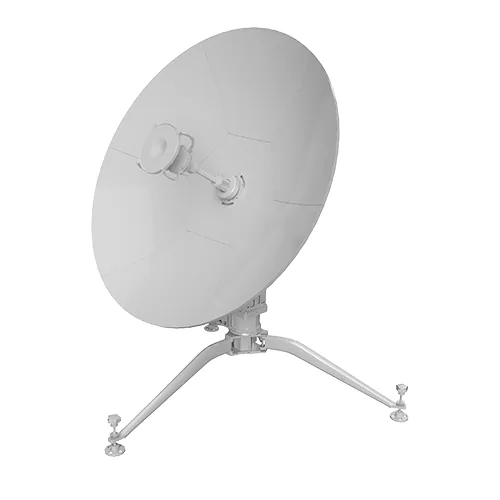
PALS Manpack Antenna (PMA Series)
The PALS Manpack Antenna (PMA Series) is a portable, quick-deploy satellite antenna available in 60cm, 90cm, 100cm and 120cm sizes, with datasheets published for the PMA-60, PMA-90 and PMA-100 models. Lightweight and rugged, the PMA Series is designed to be carried to site and assembled by one or two operators, delivering reliable connectivity for military, emergency response and remote communication needs. Easy assembly and precise alignment give dependable performance in challenging environments where no fixed infrastructure exists and a link must be established quickly.
Key Features
- Four apertures available: 60cm, 90cm, 100cm and 120cm reflectors
- Lightweight, rugged construction intended to be carried into the field
- PMA-60, PMA-90 and PMA-100 models each covered by a dedicated datasheet
- Easy assembly allows small teams to deploy without ground support equipment
- Precise alignment hardware supports dependable performance after each rebuild
- Designed for military, emergency response and remote communication roles
Technical Specifications
Typical Applications
- Military and special operations deployable communications
- Emergency response, search and rescue and civil defence
- Humanitarian and disaster relief field networks
- Remote survey, exploration and expedition connectivity
- Border security and government field teams
- Backup communications for critical infrastructure sites
What Makes a Manpack Antenna Different From a Flyaway
A manpack antenna is the most portable class of satellite terminal antenna. Where a flyaway travels in wheeled cases and expects a vehicle or aircraft at some point in the chain, a manpack is designed to be carried on a person's back over the last stretch of ground. That constraint drives everything: reflector segments must be small and light, the mount must assemble without tools or with very few, and the alignment mechanism must be usable by a tired operator in poor light. The PALS PMA Series sits squarely in this category, combining lightweight, rugged construction with easy assembly and precise alignment so that a small team can establish a link where nothing else reaches.
Choosing a PMA Series Size: 60cm, 90cm, 100cm and 120cm
Aperture and portability pull in opposite directions, and the series gives you four points on that curve. The PMA-60 is the lightest option and the easiest to carry any distance, suited to voice, messaging and moderate data rates. The PMA-90 and PMA-100 add gain for higher throughput or for links that must survive weather. The 120cm option is the highest-gain member of the range and the heaviest to move. Choose by working from the service first: establish the data rate and the satellite beam you are assigned, add margin for the worst rainfall your region produces, then take the smallest aperture that still closes the link comfortably rather than the smallest that closes it at all.
Ku-Band and C-Band Planning for Manpack Antenna Deployments
Man-portable terminals are commonly built for Ku-band because the hardware is compact and space segment is widely available across the Middle East, Africa and Europe. C-band is chosen where heavy tropical rainfall would otherwise break the link, though it needs a physically larger aperture for equivalent performance. Ka-band services offer more throughput with less weather margin. The band determines the feed, the amplifier and the modem you pair with the antenna, so it needs settling before procurement rather than after. Confirm the band and feed configuration for your chosen PMA Series model on the applicable PMA-60, PMA-90 or PMA-100 datasheet, and let GCCSAT match the RF chain to the space segment you have contracted.
Why Buy PALS PMA Series Manpack Antennas from GCCSAT in the UAE
GCCSAT is a UAE-based satellite communications integrator working with government, defence, emergency services and energy customers across the GCC and the wider Middle East. We supply these antennas together with the feed, amplifier, modem, batteries or power arrangement, cabling and carry cases that turn it into a deployable terminal, and we support commissioning and operator familiarisation at handover. Regional supply and logistics are coordinated from the UAE, keeping technical support in your own time zone. Pricing for any PMA Series model is quoted on request. Send us your band, satellite, data rate and carry-weight limits and we will recommend an aperture and a full terminal build.
Frequently Asked Questions
What sizes are available in the PALS PMA Series manpack antenna range?
The PMA Series is available in 60cm, 90cm, 100cm and 120cm sizes, with PALS publishing datasheets for the PMA-60, PMA-90 and PMA-100 models. Smaller apertures are easier to carry over distance while larger ones provide more gain for higher data rates or tougher weather. GCCSAT can help you pick the right size for your link budget and carry constraints.
What is the difference between a manpack antenna and a flyaway antenna?
A manpack antenna is built to be carried on a person's back and assembled by hand with minimal tools, so components are kept small and light. A flyaway antenna travels in transit cases and is generally larger, giving more gain but needing vehicle or air transport to site. The PMA Series is a manpack range aimed at teams that must move on foot.
Is the PMA Series suitable for military and emergency response use?
Yes. PALS designs the PMA Series for military, emergency response and remote communication needs, and the lightweight, rugged construction with easy assembly and precise alignment is aimed squarely at those roles. GCCSAT can package the antenna with a suitable modem, amplifier and field power arrangement so a response team has a complete, rehearsed terminal rather than a collection of parts.
Does GCCSAT supply PALS manpack antennas in the UAE and wider region?
Yes. GCCSAT supplies PALS Electronics antennas to customers across the UAE, Saudi Arabia, Oman, Qatar, Kuwait, Bahrain and the wider Middle East and Africa, with logistics run from our UAE base. We provide integration, commissioning and operator familiarisation alongside supply. Pricing and availability are quoted on request against the configuration you need.
How many people are needed to deploy a PMA Series antenna?
The series is designed around easy assembly and man-portable construction, which is what allows very small teams to set up without ground support equipment. In practice the number of operators and the time required depend on the aperture chosen, the terrain and how well drilled the crew is. GCCSAT recommends a familiarisation session so operators rehearse assembly, pointing and pack-down before live use.
Enquire About PALS Manpack Antenna (PMA Series)
Our sales team will provide pricing, availability, and shipping details.
Request a QuoteWhatsAppMore VSAT Flyaway Antennas
- Hughes HL1110W OneWeb LEO User Terminal
- Hughes HL1120W OneWeb LEO User Terminal
- iNetVu 1200 Drive-Away Antenna
- iNetVu 1202 Drive-Away Antenna
- iNetVu 1501 Drive-Away Antenna
- Kymeta Hawk U8 GEO Satellite System
- Kymeta Hawk U8 LEO Satellite System
- Kymeta Osprey U8 Satellite System
- OneWeb Inter FoldSAT LEO Terminal
- Probecom SNG Antenna (1.2m, 1.5m, 1.8m)
- Probecom Flyaway Antenna (0.55m, 0.75m, 1.2m, 1.8m)
- PALS Phase Array Antenna (PPA Series)
- PALS Flyaway Antenna (PFA Series)
- PALS Drive-Away Antenna (PDA Series)
- Hyper Link SNG Ku-Band Antenna 96cm and 1.2m
- C-COM iNetVu Man Pack Antenna (60cm, 80cm, 100cm, 130cm)
- C-COM iNetVu Flyaway Antenna (74cm, 98cm, 1.2m, 1.8m)
- C-COM iNetVu Driveaway Antenna (74cm, 98cm, 1.2m, 1.5m, 1.8m)
Product Categories
- VSAT BUC
- VSAT LNB
- VSAT Antennas
- VSAT Fixed Antennas
- VSAT Flyaway Antennas
- VSAT Maritime Antennas
- VSAT KingSat Antennas
- L-Band Satellite Terminals
- Cobham BGAN Terminals
- Thuraya L-Band Terminals
- VSAT Satellite Modems
- Satellite Phones
- Teltonika Products
- Sangfor Firewall & SD-WAN
- Thuraya Accessories
- Excelerate Hybrid Connectivity
- Peplink Products
- VSAT RF Components
- VSAT Hub & Test Equipment
- Remote Site Power Systems