
- Home
- Industries
Industries
Enabling transformation and progress across a wide range of industries globally, fostering innovation and growth in every sector.
Explore all → - Solutions
Connectivity
Connecting industries worldwide with reliable satellite internet solutions, driving innovation, efficiency, and growth across all sectors globally.
Explore all → - Services
Professional VSAT & IT Services
Delivering expert VSAT and IT solutions for seamless connectivity, reliability, and performance across all sectors.
Explore all → - Products
Superior Connectivity, Trusted Solutions
Offering premium Satcom products that guarantee reliable connectivity and boost innovation across industries.
Explore all → - Coverage
WorldWide Coverage
Delivering tailored satellite services that enhance connectivity, foster innovation, and support growth in every industry.
Explore all → - About
- Blog
- Contact
PALS Flyaway Antenna (PFA Series)
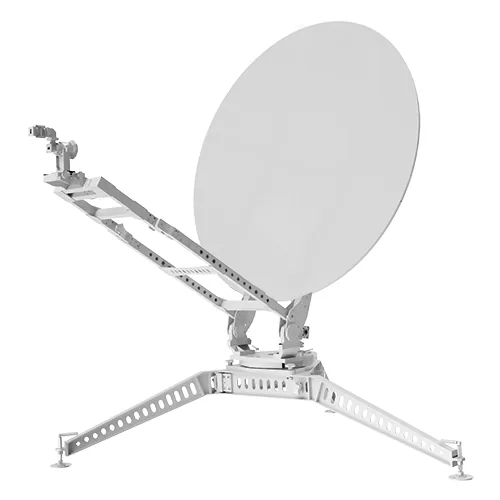
PALS Flyaway Antenna (PFA Series)
The PALS Flyaway Antenna (PFA Series) is a rapid-deployment satellite antenna available in 120cm, 150cm, 180cm, 240cm and 370cm sizes, with published datasheets covering the PFA-120, PFA-150, PFA-180 and PFA-240 models. Engineered for temporary setups in remote locations, the PFA Series combines robust construction with precision alignment for reliable signal transmission. The range suits broadcasting, emergency response and mobile operations, and the spread of apertures lets integrators choose between transportability and link margin when specifying a terminal for field use.
Key Features
- Five apertures from 120cm to 370cm cover light portable through high-gain requirements
- PFA-120, PFA-150, PFA-180 and PFA-240 models each documented on their own datasheet
- Robust construction intended for repeated transport and temporary field setups
- Precision alignment mechanisms support reliable signal transmission after each deployment
- Engineered specifically for rapid deployment in remote locations
- Suited to broadcasting, emergency response and mobile operations
Technical Specifications
Typical Applications
- Broadcast and SNG field uplinks for live coverage
- Emergency response and disaster recovery communications
- Government and defence deployable communications
- Remote mining, survey and construction site connectivity
- Oil and gas onshore field communications
- Temporary enterprise backhaul for events and projects
Where the PFA Series Flyaway Antenna Fits in a Deployable Terminal
A flyaway terminal is a satellite station broken into transportable sections that a small crew reassembles on arrival. The PFA Series supplies the reflector, feed support and alignment hardware; the modem, amplifier, power arrangement and cabling complete the station. Because the antenna is rebuilt and re-pointed for every deployment, mechanical repeatability and alignment precision matter as much as raw aperture, which is exactly what PALS emphasises for this range. When specifying a terminal, work backwards from the service you have contracted: the required data rate and the satellite beam dictate the aperture, the aperture dictates case count and crew size, and those in turn dictate how the terminal actually travels to site.
Choosing a PFA Series Aperture From 120cm to 370cm
The PFA Series spans a wide range, and the sizes are not interchangeable in practice. PFA-120 and PFA-150 sit at the transportable end, where case count and crew handling dominate and the terminal moves frequently. PFA-180 and PFA-240 give more gain for broadcast-grade contribution, higher-order modulation or work on a congested satellite. The 370cm option addresses high-gain requirements that begin to look more like a semi-permanent earth station than a flyaway. General practice is to size for the worst-case rain event in your operating region rather than for clear-sky conditions, then confirm the choice against your operator's link budget. GCCSAT engineers can run that calculation with you before you commit to a model.
Installation, Alignment and Integration Notes
Rapid-deployment antennas live or die on the alignment routine. Choose a level, stable footprint with an unobstructed line of sight to the satellite arc, and allow for ballast or anchoring appropriate to local wind conditions. Use the PFA Series alignment mechanisms methodically: coarse azimuth and elevation first, then polarisation, then fine peaking against a beacon or the operator's cross-polarisation test. Keep RF cable runs short and properly weatherproofed, and confirm grounding before transmitting. Document the settings that worked at each recurring site, because a written record makes each return visit noticeably quicker than the first one. GCCSAT provides commissioning support and crew familiarisation for terminals built on this range.
Why Buy PALS PFA Series Flyaway Antennas from GCCSAT in the UAE
GCCSAT is a UAE-based VSAT integrator supplying broadcasters, government agencies, emergency services and energy operators across the GCC and the wider Middle East and Africa. We supply these antennas with the matched feed, amplifier, modem, cabling and transit cases needed to make a working terminal, and we support installation, alignment and commissioning on handover. Regional supply and logistics are coordinated from the UAE, keeping procurement and after-sales support close to your operation. Pricing for any PFA Series model is quoted on request. Tell us your band, satellite, throughput target and transport constraints and our engineers will propose the right aperture and a complete terminal build.
Frequently Asked Questions
What sizes are available in the PALS PFA Series flyaway antenna range?
The PFA Series is available in 120cm, 150cm, 180cm, 240cm and 370cm sizes. PALS publishes datasheets for the PFA-120, PFA-150, PFA-180 and PFA-240 models. The smaller apertures favour transportability while the larger ones give the extra gain needed for demanding links, so GCCSAT normally selects the model against your required data rate and satellite beam.
What is the difference between the PFA Series flyaway and the PDA Series drive-away?
A PFA Series flyaway antenna is packed into cases, transported to site and assembled by hand, which suits air freight and locations vehicles cannot reach. A drive-away antenna stays mounted on a vehicle and deploys from it, trading portability for faster setup. Both PALS ranges target rapid deployment; the choice depends on whether your terminal travels by aircraft or by road.
How quickly can a PFA Series antenna be deployed in the field?
The series is engineered for rapid deployment, but real set-up time depends on the aperture you choose, the terrain, the weather and how practised the crew is. A 120cm terminal will always assemble faster than a 240cm one. GCCSAT recommends rehearsed procedures and a familiarisation session at handover so crews achieve consistent times on live deployments.
Does GCCSAT supply PALS PFA Series antennas across the Middle East?
Yes. GCCSAT supplies PALS Electronics antennas to customers in the UAE, Saudi Arabia, Oman, Qatar, Kuwait, Bahrain and the wider Middle East and Africa, with logistics handled from our UAE operation. We can supply the antenna alone or as part of a complete deployable terminal with commissioning support. Pricing and availability are quoted on request.
Which band does the PFA Series operate in?
Band and feed configuration are specified per model on the individual PFA-120, PFA-150, PFA-180 and PFA-240 datasheets rather than in the general series description, so GCCSAT confirms them against your space segment at quotation. Tell us which satellite operator and beam you are contracted to and we will specify the matching feed, amplifier and modem for the terminal.
Enquire About PALS Flyaway Antenna (PFA Series)
Our sales team will provide pricing, availability, and shipping details.
Request a QuoteWhatsAppMore VSAT Flyaway Antennas
- Hughes HL1110W OneWeb LEO User Terminal
- Hughes HL1120W OneWeb LEO User Terminal
- iNetVu 1200 Drive-Away Antenna
- iNetVu 1202 Drive-Away Antenna
- iNetVu 1501 Drive-Away Antenna
- Kymeta Hawk U8 GEO Satellite System
- Kymeta Hawk U8 LEO Satellite System
- Kymeta Osprey U8 Satellite System
- OneWeb Inter FoldSAT LEO Terminal
- Probecom SNG Antenna (1.2m, 1.5m, 1.8m)
- Probecom Flyaway Antenna (0.55m, 0.75m, 1.2m, 1.8m)
- PALS Phase Array Antenna (PPA Series)
- PALS Manpack Antenna (PMA Series)
- PALS Drive-Away Antenna (PDA Series)
- Hyper Link SNG Ku-Band Antenna 96cm and 1.2m
- C-COM iNetVu Man Pack Antenna (60cm, 80cm, 100cm, 130cm)
- C-COM iNetVu Flyaway Antenna (74cm, 98cm, 1.2m, 1.8m)
- C-COM iNetVu Driveaway Antenna (74cm, 98cm, 1.2m, 1.5m, 1.8m)
Product Categories
- VSAT BUC
- VSAT LNB
- VSAT Antennas
- VSAT Fixed Antennas
- VSAT Flyaway Antennas
- VSAT Maritime Antennas
- VSAT KingSat Antennas
- L-Band Satellite Terminals
- Cobham BGAN Terminals
- Thuraya L-Band Terminals
- VSAT Satellite Modems
- Satellite Phones
- Teltonika Products
- Sangfor Firewall & SD-WAN
- Thuraya Accessories
- Excelerate Hybrid Connectivity
- Peplink Products
- VSAT RF Components
- VSAT Hub & Test Equipment
- Remote Site Power Systems