
- Home
- Industries
Industries
Enabling transformation and progress across a wide range of industries globally, fostering innovation and growth in every sector.
Explore all → - Solutions
Connectivity
Connecting industries worldwide with reliable satellite internet solutions, driving innovation, efficiency, and growth across all sectors globally.
Explore all → - Services
Professional VSAT & IT Services
Delivering expert VSAT and IT solutions for seamless connectivity, reliability, and performance across all sectors.
Explore all → - Products
Superior Connectivity, Trusted Solutions
Offering premium Satcom products that guarantee reliable connectivity and boost innovation across industries.
Explore all → - Coverage
WorldWide Coverage
Delivering tailored satellite services that enhance connectivity, foster innovation, and support growth in every industry.
Explore all → - About
- Blog
- Contact
Teltonika Products
Teltonika Products
Teltonika industrial cellular routers and IoT gateways providing reliable LTE and LTE-M/NB-IoT connectivity for remote monitoring, M2M communications, and hybrid satellite-cellular deployments.
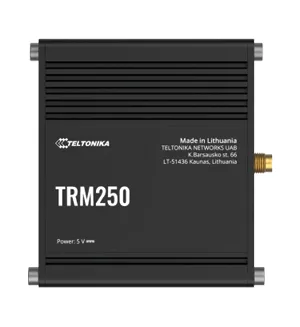

How to Choose a Teltonika Industrial Router
Start with the radio, not the enclosure. The first question is which cellular technology the application genuinely needs. A telemetry site sending a few kilobytes an hour is a poor fit for a high throughput LTE router, and a busy remote office is badly served by an LTE-M or NB-IoT gateway. Confirm the frequency bands your operator uses in every country of deployment, because a variant built for one region may not carry the bands you need in another. Next look at the field interfaces. Serial ports, digital inputs and outputs and relay contacts decide whether the router can talk to the equipment already installed, or whether you will be buying protocol converters as well. Then check the physical envelope: DIN rail or panel mounting, the DC input range against your solar or vehicle supply, and the operating temperature rating against a rooftop cabinet in a Gulf summer. Management comes last in the evaluation but decides what the fleet costs you to run.
Teltonika TRB Gateways vs Full Router Platforms
The Teltonika range splits roughly into compact gateways and full router platforms, and picking the wrong side of that line is the most common procurement error. Gateways such as the TRB250 and TRB256 are small, focused devices built to put a single remote asset onto a cellular network: a meter, a PLC, a sensor cluster, a controller sitting behind a serial link. They typically present one Ethernet port plus a set of industrial interfaces, and they are dimensioned for modest, steady traffic rather than many concurrent users. Router platforms sit above them and add switch ports, Wi-Fi, dual SIM, additional WAN options and higher forwarding performance, which is what a site with staff, cameras or a local LAN actually requires. If the requirement is telemetry and remote access to one machine, a gateway is the simpler and lower overhead answer. If the site behaves like a small branch office, specify a router from the outset and avoid a rip and replace later.
Key Specifications to Compare on a Teltonika Datasheet
Six lines on the datasheet usually decide the purchase. The cellular category tells you the realistic throughput ceiling and, just as importantly, whether the device is designed for narrowband IoT traffic or general internet access. The band list must be matched to your operator, not to a generic region name. SIM slot count determines whether you can hold a primary and a backup profile in the same box. The serial and I/O complement decides integration effort with legacy equipment. The DC input range matters more than people expect on solar, vehicle and 24 V industrial supplies, where voltage sags are routine. Operating temperature range should be read together with the mounting location rather than in isolation. Beyond those, check VPN support and whether the quoted throughput figure is raw routing or measured through an encrypted tunnel, since the two can differ substantially. Finally, confirm firmware and central management support, because that is what keeps a distributed fleet maintainable.
Pairing Teltonika Gateways with VSAT and Satellite Backhaul
Cellular and satellite are complements, not competitors, and hybrid designs are where these gateways earn their place. A common pattern uses the VSAT terminal as the primary path for a remote site and a cellular gateway as the out of band route, so that when the satellite link degrades you still reach the modem, the ACU and the site router to diagnose it. The reverse pattern is equally valid: cellular as the everyday bearer where coverage exists, with satellite carrying the traffic whenever the site moves beyond the network edge. Either way, plan the routing policy before you buy. Decide which subnets fail over automatically, which latency sensitive traffic should be kept off the geostationary satellite path and steered to cellular whenever it is available, and which telemetry should be allowed to run up cellular usage unattended. Watchdog and periodic reboot functions are worth configuring on unmanned sites. GCCSAT can advise on integrating cellular gateways alongside VSAT terminals and SD-WAN appliances as part of a single connectivity design.
Buying Teltonika Industrial Routers in the UAE and Wider GCC
Two practical issues dominate regional procurement of industrial cellular hardware. The first is regulatory: radio equipment placed on the market in the UAE falls under TDRA type approval, and other GCC and African states run their own national regimes, so confirm the approval status for the destination country rather than assuming a European or global variant travels unchanged. The second is operator alignment. Band support, APN configuration and M2M SIM provisioning are handled by the local mobile operator, and a router that performs well in one market can underperform in another simply because of band mismatch. Environment is the third factor worth planning for, given ambient temperatures across the Gulf and dust ingress at desert and quarry sites. GCCSAT supplies Teltonika industrial routers and IoT gateways to customers across the UAE, the wider GCC, MENA and Africa, and quotes on request against your band, interface and deployment requirements.
Teltonika Products — Frequently Asked Questions
What is a Teltonika industrial router used for?
A Teltonika industrial router connects remote equipment to a cellular network so it can be monitored and controlled over IP. Typical uses are SCADA and telemetry backhaul, remote access to PLCs and controllers, unattended site monitoring, digital signage, vehicle and fleet connectivity, and cellular failover for a fixed line or satellite service. Unlike consumer routers they are built for continuous operation in wide temperature ranges, run from DC supplies, and expose serial and digital I/O for industrial equipment.
What is the difference between the Teltonika TRB250 and TRB256?
Both are compact TRB series gateways aimed at machine to machine and IoT connectivity rather than high throughput branch networking, and both expose industrial interfaces alongside a single Ethernet port. The practical difference between them lies in the cellular radio generation and band support, which determines which networks and which traffic profiles each one suits. Because band plans vary by country and by operator, confirm the exact variant against your target network before ordering. GCCSAT can check current variants and interface options for your application.
Can a Teltonika router work alongside a VSAT satellite link?
Yes. Cellular gateways are routinely deployed alongside VSAT terminals in two ways. As a backup bearer, the gateway takes over when the satellite service is unavailable or when weather degrades the link. As an out of band management path, it keeps you connected to the site router, satellite modem and antenna controller even when the primary link is down, which is what makes remote fault diagnosis possible. Define the failover policy, routing priorities and usage limits during design rather than after deployment.
Do I need an external antenna for a Teltonika gateway?
Usually yes for any serious deployment. Metal cabinets, concrete plant rooms, vehicle bodies and vessel superstructures all attenuate cellular signal badly, and a gateway mounted inside one of them will suffer throughput loss and repeated reconnections. An external antenna mounted with clear line of sight to the network, with a cable run kept as short as practical, is the single most effective change to link quality. Match the antenna band coverage and connector type to the gateway, and fit surge protection on exposed masts.
Which LTE bands do I need for the UAE and Saudi Arabia?
Band selection follows the operator, not the country label on a datasheet. Middle East and African networks commonly use a mixture of FDD bands in the 800, 900, 1800 and 2100 MHz ranges alongside TDD spectrum around 2300 and 2600 MHz, but the exact combination differs between operators and between urban and rural sites. Ask your mobile operator which bands serve the specific site, then match the router variant to that list. A band mismatch is the most frequent cause of poor performance in imported hardware.
Can GCCSAT supply Teltonika routers in the UAE and across MENA and Africa?
Yes. GCCSAT supplies Teltonika industrial cellular routers and IoT gateways from the UAE to customers across the GCC, wider MENA region and Africa, including hybrid deployments where the cellular gateway sits alongside a VSAT terminal or an SD-WAN appliance. Send the application, the required interfaces, the operator or bands involved and the destination country, and GCCSAT will confirm the appropriate model and quote on request. Regulatory approval requirements for the destination market are confirmed as part of that process.
Product Categories
- VSAT BUC
- VSAT LNB
- VSAT Antennas
- VSAT Fixed Antennas
- VSAT Flyaway Antennas
- VSAT Maritime Antennas
- VSAT KingSat Antennas
- L-Band Satellite Terminals
- Cobham BGAN Terminals
- Thuraya L-Band Terminals
- VSAT Satellite Modems
- Satellite Phones
- Teltonika Products
- Sangfor Firewall & SD-WAN
- Thuraya Accessories
- Excelerate Hybrid Connectivity
- Peplink Products
- VSAT RF Components
- VSAT Hub & Test Equipment
- Remote Site Power Systems
Need a Quote?
Contact our sales team for pricing, availability, and shipping to your location.
Request QuoteWhatsApp