
- Home
- Industries
Industries
Enabling transformation and progress across a wide range of industries globally, fostering innovation and growth in every sector.
Explore all → - Solutions
Connectivity
Connecting industries worldwide with reliable satellite internet solutions, driving innovation, efficiency, and growth across all sectors globally.
Explore all → - Services
Professional VSAT & IT Services
Delivering expert VSAT and IT solutions for seamless connectivity, reliability, and performance across all sectors.
Explore all → - Products
Superior Connectivity, Trusted Solutions
Offering premium Satcom products that guarantee reliable connectivity and boost innovation across industries.
Explore all → - Coverage
WorldWide Coverage
Delivering tailored satellite services that enhance connectivity, foster innovation, and support growth in every industry.
Explore all → - About
- Blog
- Contact

Kymeta Flat Panel Terminals
Kymeta u8 Electronically Steered Flat Panel Antennas
Kymeta builds flat panel satellite terminals that steer their beams electronically instead of turning a dish, which suits vehicles, vessels and rapid-deployment kits where a gimballed antenna is impractical. GCCSAT supplies, integrates and supports Kymeta u8 terminals for customers who need connectivity on the move, configuring them for Eutelsat OneWeb LEO service, geostationary Ku-band networks or cellular, and tying them into a Peplink SD-WAN with the rest of your links.
Below we explain how Kymeta's metamaterial technology works, how the Hawk u8, Peregrine u8, Goshawk u8 and Osprey u8 differ, and what to weigh before choosing a flat panel over a parabolic antenna. If you are comparing OneWeb terminals across brands, our OneWeb solutions page sets Kymeta alongside Intellian and Hughes options.
At a glance
Zero moving parts
With no motors or gimbals to wear out, Kymeta terminals are well suited to rough roads, vibrating decks and field kits that are packed and unpacked often.
Made for comms on the move
Kymeta's pointing and tracking keep the beam on the satellite while a vehicle or vessel moves, so teams stay connected without stopping to reacquire the signal.
LEO, GEO and cellular paths
Depending on the model, u8 terminals work over Eutelsat OneWeb, geostationary Ku-band networks or built-in cellular, giving one antenna more than one route home.
Low power for field use
The Hawk u8 needs less than 100 W nominal power, so it can run from generators, solar panels or other alternative power at remote and temporary sites.
How Kymeta's Electronically Steered Antenna Works
A conventional VSAT dish points at a satellite by physically turning. Kymeta's antennas use a liquid crystal metamaterial surface instead: software controls how each element passes radio energy, and the combined pattern forms a beam that is pointed and polarized electronically. The terminal acquires and tracks satellites automatically, without a mechanical gimbal. Kymeta says its metamaterial layer generates little heat compared with conventional phased arrays, which helps keep power draw low. The result is a thin, rugged panel that can sit low on a vehicle roof or deck and keep tracking through motion and vibration.
Comparing the Kymeta Hawk u8, Peregrine u8, Goshawk u8 and Osprey u8
All four share the u8 platform but target different users. The Hawk u8 is the land terminal, preconfigured for either LEO or GEO service and mounted on vehicle racks, on poles or in a transport case. The Peregrine u8 is Kymeta's purpose-built maritime terminal for Eutelsat OneWeb, with hybrid cellular for coastal waters. The Goshawk u8 combines embedded LEO and cellular modems with support for an external GEO modem, while the Osprey u8 provides multi-orbit, multi-network access for defense and government operators.
- Hawk u8: land vehicles, fixed poles and transportable kits
- Peregrine u8: freighters, fishing vessels and yachts
- Goshawk u8: security and government missions
- Osprey u8: defense users needing GEO, LEO and cellular
Flat Panel or Parabolic: The Trade-offs to Consider
Flat panels win on profile, weight and resistance to vibration, but physics still applies. An electronically steered aperture loses some gain as it scans toward the horizon, so performance can dip at low elevation angles, and a larger parabolic dish generally offers more gain on the same network. Like any satellite antenna, a Kymeta panel needs a clear view of the sky, and roof racks, masts or cargo can shadow it. We assess these factors for your routes and sites before recommending a flat panel, a parabolic terminal or a mix of both.
Integrating Kymeta Terminals into a Resilient Network
A Kymeta terminal hands an Ethernet connection to your network, so we pair it with a Peplink router that can bond it with Starlink, VSAT or cellular and keep sessions running if the panel is blocked. For vehicle fits, we plan the roof rack, cable entry and power feed with your fleet workshop; on vessels, we position the panel clear of masts and radar. Each terminal is commissioned on its selected network, set up for remote management through Kymeta's tools and our NOC, and supported by our engineers with remote troubleshooting and spares planning.
Kymeta terminals
 Kymeta Hawk U8 GEO Satellite SystemKymeta Hawk U8 GEO satellite system with electronically steered flat-panel for reliable GEO connectivity on vehicles.
 Kymeta Hawk U8 LEO Satellite SystemKymeta Hawk U8 LEO satellite system with electronically steered flat panel for high-throughput mobile LEO connectivity.
 Kymeta Osprey U8 Satellite SystemKymeta Osprey U8 satellite system for multi-orbit connectivity on vehicles requiring continuous broadband.
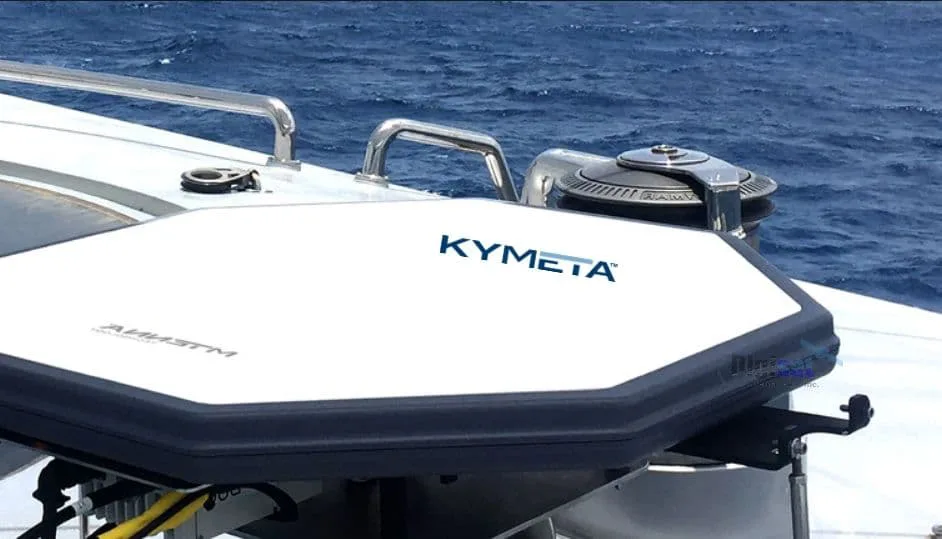 Kymeta KM-P8Kymeta KM-P8 electronically steered maritime antenna for multi-orbit satellite connectivity.Kymeta KM-P8+EKymeta KM-P8+E enhanced maritime ESA with multi-orbit satellite and integrated cellular backup.Kymeta KM-P8EKymeta KM-P8E enterprise-grade maritime ESA for reliable vessel satellite communications.
 Kymeta Peregrine U8Kymeta Peregrine U8 advanced multi-orbit maritime satellite system for seamless LEO and GEO operations.
Frequently Asked Questions
What is the Kymeta Hawk u8?
The Hawk u8 is Kymeta's land terminal, an electronically steered flat panel that can be preconfigured for LEO or GEO satellite networks. It is designed for connectivity on the move, mounts on vehicle roof racks or fixed poles, and draws less than 100 W nominal power, so it can run from off-grid sources.
Do Kymeta antennas work with OneWeb?
Yes. Kymeta terminals including the Hawk u8, Peregrine u8 and Goshawk u8 operate on the Eutelsat OneWeb LEO network, and some models can also use geostationary Ku-band services or cellular. GCCSAT configures the terminal for your chosen network and can supply OneWeb service through our Eutelsat OneWeb partnership.
What does electronically steered antenna mean?
It means the antenna points its beam with electronics rather than motors. The panel stays fixed while the beam is steered across the sky to find and follow satellites, which is essential for tracking fast-moving LEO satellites from moving platforms without mechanical wear.
Is a Kymeta panel suitable for a vessel?
Yes. The Peregrine u8 is Kymeta's maritime terminal for Eutelsat OneWeb, with built-in motion compensation, a low-profile hydrophobic shell and hybrid cellular capability. It suits freighters, fishing vessels and yachts where mast space and weight are limited. For large ships with heavy data demand, we may combine it with a parabolic terminal.
Do you support Kymeta terminals for government and defense users?
Yes. The Goshawk u8 and Osprey u8 are designed for security, government and defense missions, with multi-orbit options, and the Goshawk is built to operate in GNSS-denied environments. GCCSAT supplies, integrates and supports these terminals, subject to any export or end-user requirements that apply.
Related Solutions
Talk to a GCCSAT engineer
Tell us where you operate and what you need to connect. We reply within 24 hours with a recommended design.