
- Home
- Industries
Industries
Enabling transformation and progress across a wide range of industries globally, fostering innovation and growth in every sector.
Explore all → - Solutions
Connectivity
Connecting industries worldwide with reliable satellite internet solutions, driving innovation, efficiency, and growth across all sectors globally.
Explore all → - Services
Professional VSAT & IT Services
Delivering expert VSAT and IT solutions for seamless connectivity, reliability, and performance across all sectors.
Explore all → - Products
Superior Connectivity, Trusted Solutions
Offering premium Satcom products that guarantee reliable connectivity and boost innovation across industries.
Explore all → - Coverage
WorldWide Coverage
Delivering tailored satellite services that enhance connectivity, foster innovation, and support growth in every industry.
Explore all → - About
- Blog
- Contact

Hughes LEO and VSAT
Hughes OneWeb Terminals and Hughes VSAT Equipment
Hughes Network Systems builds two families of equipment that matter to remote operations: electronically steered flat panel terminals for the Eutelsat OneWeb LEO network, and the JUPITER System VSAT platform that satellite operators use for enterprise broadband and cellular backhaul. GCCSAT supplies, integrates and supports Hughes terminals, handling the site survey, installation, activation and long-term support, and links them with Peplink SD-WAN when a site needs backup or extra capacity.
The sections below compare the Hughes HL1100W and HL1120W, explain how they are installed and commissioned, and show where Hughes VSAT terminals fit alongside LEO links and cellular backup. OneWeb service for these terminals is supplied through our Eutelsat OneWeb partnership, for sites and projects outside the UAE, where satellite internet services are not sold.
At a glance
Self-aligning flat panels
Both Hughes OneWeb terminals use electronically steered antennas with no moving parts that find and track satellites automatically, so there is no dish to point or service.
Two sizes, two roles
The single-panel HL1100W is a compact option for lighter demand and backup, while the HL1120W uses separate transmit and receive panels for higher throughput.
Wi-Fi 6 indoor unit
Each kit pairs the outdoor antenna with an indoor unit offering Wi-Fi 6 and Gigabit Ethernet, so small sites can connect users without extra networking hardware.
Fixed or rapid deployment
Eutelsat lists the HL1120W for land fixed and comms-on-the-pause use, meaning it can be set up quickly at temporary sites and operated while stationary.
Hughes HL1100W vs HL1120W: Choosing a OneWeb Flat Panel
Both terminals are designed for fixed and transportable land use on Eutelsat OneWeb's Ku-band LEO network. The HL1120W is the higher-throughput model: its outdoor unit uses two electronically steered panels, one for transmit and one for receive, giving full-duplex operation for busy offices, cellular backhaul and enterprise sites. The HL1100W uses a single panel that handles both directions in half-duplex mode, so it is lighter and smaller but delivers lower peak rates, which suits backup links, small teams and emergency kits. We select between them by expected user demand, available power and mounting options.
Installing and Commissioning a Hughes LEO Terminal
The outdoor unit needs an unobstructed view of the sky and a secure roof, wall or pole mount, and it connects to the indoor unit over a coaxial inter-facility link whose cable type depends on run length. Hughes terminals self-align: once powered, they find and track OneWeb satellites automatically, and setup and activation are completed with the Hughes LEO mobile app. We add grounding and surge protection suited to the site, connect the indoor unit to your LAN or Peplink router, and commission the link with throughput and stability tests before handover.
- Sky-view survey and mount selection
- Coaxial cable sized to the run length
- Grounding and surge protection
- Activation with the Hughes LEO app
- Throughput tests, handover and NOC monitoring
Hughes VSAT: JUPITER System Terminals for Geostationary Networks
Hughes JUPITER is a VSAT platform used by satellite operators on conventional and high-throughput satellites in C-, Ku- and Ka-band, with DVB-S2X on the forward link and adaptive coding on the return link. Terminals such as the HT2000W, which adds integrated Wi-Fi, and the HT2300, which works with C-, Ku- or Ka-band outdoor units, connect remote sites to a service provider's JUPITER hub. Because a Hughes terminal must match the operator's hub platform, we confirm network compatibility, frequency band and outdoor unit sizing before supplying equipment for enterprise, community Wi-Fi or backhaul projects.
Pairing Hughes Terminals with Other Links and NOC Support
A Hughes OneWeb terminal and a JUPITER VSAT link complement each other: LEO brings low latency for interactive applications, while geostationary VSAT provides a steady path over wide beams. Behind them, a Peplink router can prioritize traffic, bond links or fail over automatically, and 4G or 5G can be added where coverage exists. Once a site is live, our 24/7 NOC monitors the terminals and coordinates with the satellite network operator, so faults are diagnosed quickly and field visits are planned only when hardware needs attention.
Hughes terminals
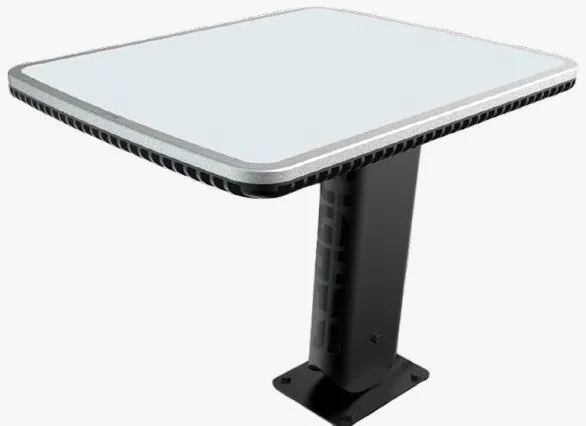 Hughes HL1100W Flat Panel Satellite TerminalCompact flat panel satellite terminal from Hughes with an integrated high-performance modem, delivering broadband internet, VoIP and data connectivity at remote and underserved sites.
 Hughes HL1110W OneWeb LEO User TerminalHughes HL1110W OneWeb LEO user terminal for high-speed broadband via the OneWeb satellite constellation.Hughes HL1120W OneWeb LEO User TerminalHughes HL1120W OneWeb LEO user terminal with enhanced throughput for demanding connectivity requirements.
Frequently Asked Questions
What is the Hughes HL1120W?
The HL1120W is the higher-throughput Hughes user terminal for Eutelsat OneWeb. It uses electronically steered flat panels with no moving parts, aligns itself automatically and comes with an indoor unit providing Wi-Fi 6 and Gigabit Ethernet. It is intended for fixed sites and rapid deployments that operate while stationary, not for use in motion.
Is the HL1100W suitable as a backup link?
Yes. Its compact single-panel design makes the HL1100W a practical secondary link for enterprise sites, and Eutelsat positions it for emergency response and enterprise backup. Paired with a Peplink router, it can take over automatically when fiber, microwave or VSAT fails, or carry selected traffic every day.
Can Hughes OneWeb terminals be used on vessels or vehicles?
The HL1100W and HL1120W are designed for land use while stationary. For vessels we recommend stabilized or maritime flat panel OneWeb terminals, and for vehicles that must stay connected while moving, land-mobility terminals such as the Kymeta Hawk u8. Our OneWeb solutions page compares the options.
Do I need a specific service provider for Hughes VSAT?
Yes. Hughes JUPITER terminals operate on networks built around a compatible JUPITER hub, so the terminal must match the operator's platform, frequency band and configuration. GCCSAT checks compatibility before supplying hardware and can propose Ka-, Ku- or C-band VSAT services to suit your location.
What support does GCCSAT provide after installation?
Every terminal we install can be enrolled in our 24/7 NOC monitoring. We track link status, investigate alarms, coordinate with the satellite operator, push configuration changes remotely where possible, and arrange site visits or replacement units when hardware fails, keeping you informed throughout.
Related Solutions
Talk to a GCCSAT engineer
Tell us where you operate and what you need to connect. We reply within 24 hours with a recommended design.