
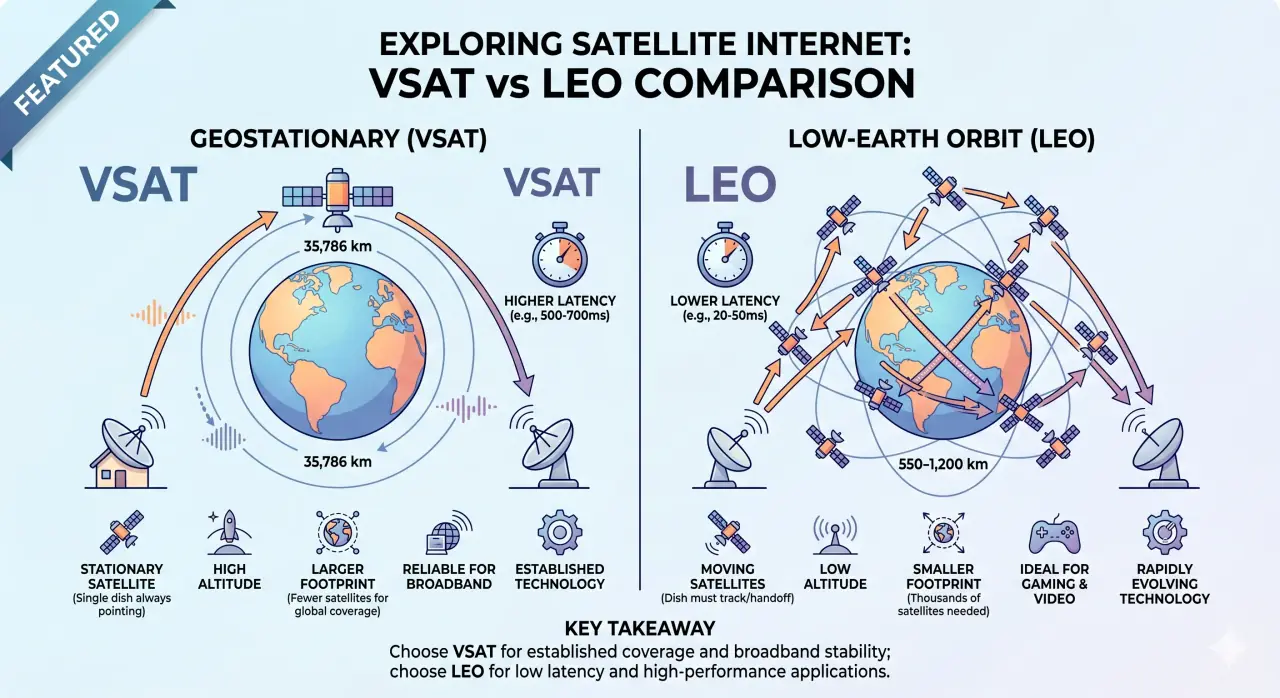
The satellite internet market now offers two fundamentally different technologies: traditional VSAT (Very Small Aperture Terminal) using geostationary satellites, and new LEO (Low Earth Orbit) constellations like Starlink and OneWeb. Both have genuine strengths, and the right choice depends on your specific requirements, location, and budget.
Technical Comparison
| Feature | VSAT (GEO) | LEO (Starlink/OneWeb) |
|---|---|---|
| Orbital Altitude | 35,786 km | 550-1,200 km |
| Latency | 600-800ms | 20-50ms |
| Throughput | 1-100 Mbps | 50-300 Mbps |
| Coverage | Regional (fixed beam) | Global including poles |
| Weather Impact | Ka-Band: moderate; C-Band: minimal | Moderate |
| SLA Options | Enterprise SLAs available | Consumer to enterprise |
| Contract Flexibility | Typically 1-3 year contracts | Monthly to annual |
When to Choose VSAT
- You require guaranteed bandwidth with enterprise SLAs
- You operate in a fixed location and need predictable costs
- Your applications can tolerate higher latency (file transfers, email, IoT data)
- You need C-Band for all-weather reliability in tropical regions
- Long-term cost stability is more important than peak performance
When to Choose LEO (Starlink/OneWeb)
- Low latency is critical for your applications (VoIP, video conferencing, real-time control)
- You operate in high-latitude areas (Arctic routes, polar regions)
- You need mobility with a terminal that works on-the-move
- You want high throughput for large file transfers or streaming
The Hybrid Solution
For most enterprise applications, the optimal solution is a hybrid approach: VSAT for primary guaranteed bandwidth with LEO satellite for low-latency applications and backup capacity. GCCSAT's Peplink-managed hybrid solutions combine the best of both technologies with intelligent traffic routing.
Contact GCCSAT for a connectivity assessment tailored to your specific requirements and geography.