
VSAT vs LEO Satellite Internet: A Detailed Comparison for Industry Decision-Makers
By GCCSAT Editorial Team • April 29, 2026 • 8 min read
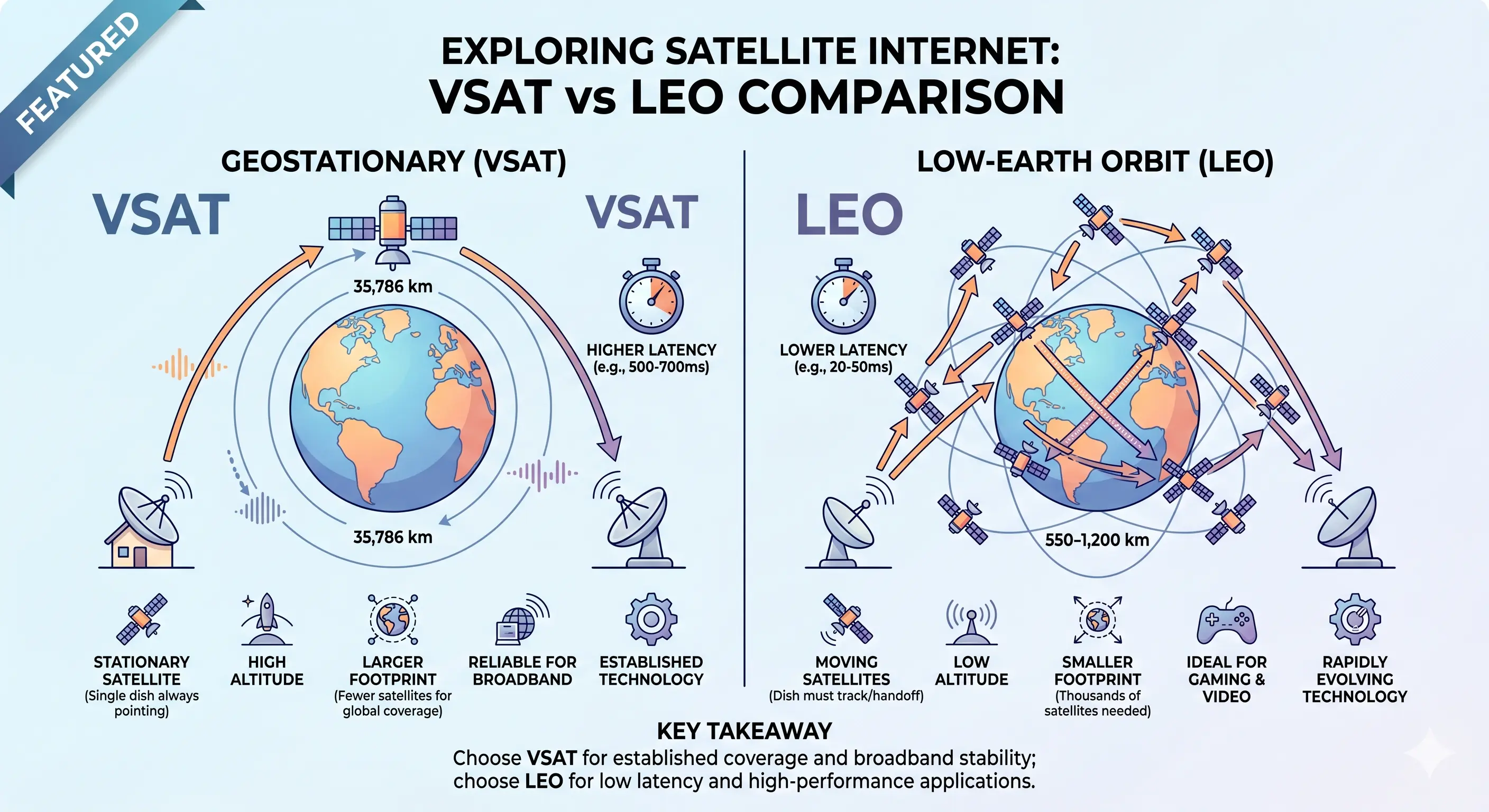
The satellite internet landscape has changed more in the past four years than in the previous two decades. LEO (Low Earth Orbit) constellations from Starlink and OneWeb have moved from experimental systems to commercially deployed networks serving paying customers across multiple continents. The question that used to be "do we use VSAT or something else?" has become a genuinely complex decision with real trade-offs on both sides.
We get asked this question constantly by clients across oil and gas, maritime, mining, government, and NGO sectors. The honest answer is that there is no universal winner. VSAT and LEO satellite internet have meaningfully different characteristics, and the right choice depends on your specific operational requirements, geographic location, and risk tolerance. Anyone telling you one technology is simply better than the other isn't giving you a useful answer.
This comparison is our attempt to lay out the facts as they actually stand in 2026, without the marketing hype that surrounds both technologies.
The Fundamental Architecture Difference
To understand why the two technologies behave so differently, you need to understand the physics involved.
VSAT (Very Small Aperture Terminal) in the traditional sense communicates with geostationary (GEO) satellites orbiting at approximately 35,786 kilometres above the equator. At this altitude, the satellite appears stationary relative to the Earth's surface — a fixed point in the sky. This makes antenna pointing simple and the link inherently predictable. The trade-off is the enormous signal travel distance: a round trip from ground to satellite and back covers roughly 71,000 km, which imposes an unavoidable latency minimum of around 480 ms — and in practice, including processing delays, 550–650 ms round-trip.
LEO satellites (Starlink operates at 550–570 km, OneWeb at 1,200 km) are dramatically closer. This proximity is why latency is 20–40 ms for Starlink — the physics are fundamentally better. But the proximity creates a different problem: at LEO altitudes, satellites orbit the Earth every 90–115 minutes. They move continuously across the sky. To maintain constant coverage, you need hundreds or thousands of satellites working in coordinated constellations, with sophisticated inter-satellite and ground-to-satellite handover systems.
This architectural difference cascades through almost every other characteristic of the two technologies.
Latency: The LEO Advantage and Its Nuances
LEO's latency advantage is real and significant. Let's put numbers on it:
- GEO VSAT (Ka/Ku/C-band): 550–650 ms round-trip latency, consistent and predictable
- Starlink LEO: 20–60 ms round-trip latency, variable
- OneWeb LEO: 30–80 ms round-trip latency, variable
For many applications, this difference is transformative. VoIP telephony starts to degrade noticeably above 150 ms one-way latency — GEO VSAT sits uncomfortably close to or beyond this threshold. Video conferencing is noticeably more natural over LEO. Remote desktop protocols (RDP, VNC, and similar) are dramatically more responsive. For any application that involves human interaction with a remote system, LEO wins clearly.
But the nuance matters. That 20–60 ms LEO figure has a wider range than the 550–650 ms GEO figure. LEO latency is variable because satellite handovers — the transition from one satellite to the next as they cross the sky — introduce brief perturbations. In a well-designed LEO network like Starlink, these handovers are largely invisible for most applications. But for applications sensitive to jitter (the variation in latency), LEO's slightly less predictable behaviour can be a consideration. GEO VSAT, for all its latency disadvantages, delivers latency as consistent as clockwork.
For SCADA systems — which are typically designed to operate over satellite and already have high-latency tolerance built in — the latency difference between VSAT and LEO is largely irrelevant. For autonomous equipment control where sub-100 ms response times matter, LEO is clearly superior.
Bandwidth and Throughput: The Evolving Picture
Five years ago, VSAT Ka-band HTS (High Throughput Satellite) systems had a clear bandwidth advantage over nascent LEO constellations. That gap has largely closed, and in some markets has reversed.
Current real-world throughput figures (not marketing maximums):
- Ka-band VSAT (HTS): 10–100 Mbps download, 2–20 Mbps upload, depending on terminal size and beam capacity allocation
- Ku-band VSAT: 2–30 Mbps download, 0.5–5 Mbps upload
- C-band VSAT: 2–20 Mbps download, 0.5–5 Mbps upload
- Starlink Business: 100–220 Mbps download, 10–40 Mbps upload (in capacity-rich markets)
- OneWeb Enterprise: 50–150 Mbps download, 10–30 Mbps upload
Starlink's raw throughput numbers in mature market areas (Europe, North America) are impressive. In MENA and Africa, the picture is more variable. Starlink's coverage in these regions is improving rapidly — SpaceX has been launching additional satellites specifically targeted at improving capacity over underserved regions — but it remains less consistent than in regions where the constellation is denser.
VSAT bandwidth is allocated and committed. When you contract for a 20 Mbps dedicated Ka-band link, you get 20 Mbps. When you contract for a managed service with guaranteed SLAs, those SLAs are enforceable. Starlink's commercial service tiers include "Best Effort" data deprioritisation during peak periods, which means your 200 Mbps can become 50 Mbps at busy times without contractual recourse on standard tiers.
Reliability and Availability: The Case for GEO
This is where the VSAT argument is strongest, and it's worth dwelling on.
GEO VSAT availability is a function of link margin engineering, rain fade mitigation, and terminal hardware quality. A properly designed Ku-band link in most operating environments delivers 99.5–99.8% availability. A well-engineered Ka-band link with appropriate fade margin can hit 99.5%+ in most tropical environments. C-band links can exceed 99.9% availability in virtually any weather.
These figures are predictable and can be contractually guaranteed. The physics of GEO satellite links are well-understood, and link budget calculations are a mature engineering discipline. An experienced satellite network engineer can tell you with high confidence what availability you'll get at a specific location before you install anything.
LEO satellite availability is more complex to characterise. When Starlink or OneWeb is working well, it works very well. But the system's reliability depends on: constellation density over your location (improving over time), ground station proximity (affects routing), local obstruction — even small objects in the field of view can cause brief outages — and the maturity of handover algorithms in your operating region.
Some Starlink users in MENA and Africa report occasional outages of 1–5 minutes during adverse conditions. Others report near-perfect uptime. The variability is real, and it's improving with each satellite launch and software update — but it's harder to contractually guarantee than VSAT performance.
For critical infrastructure — oil and gas SCADA, government emergency communications, safety systems — this predictability gap matters enormously. A 99.5% available GEO VSAT link means 43.8 hours of outage per year. Most of that is in predictable, manageable windows. An LEO link at the same headline availability number might deliver that time in more frequent, less predictable short outages — which is often worse from an operational perspective.
Coverage: Where Each Technology Reaches
GEO VSAT coverage is geographically comprehensive. A single GEO satellite covers roughly one-third of the Earth's surface. The combined coverage of available commercial Ka, Ku, and C-band satellites covers virtually every land area in MENA, Africa, and Europe — often with multiple overlapping beams providing redundant coverage options.
Polar regions (above approximately 75–80° latitude) are the notable gap for GEO satellites, which are limited to equatorial and mid-latitude orbits. For most commercial operations in MENA, Africa, and European waters, this is irrelevant.
LEO coverage for Starlink currently extends from approximately 70°N to 70°S latitude. OneWeb's higher orbit (1,200 km versus Starlink's 550 km) gives it genuine polar coverage to approximately 90° — a meaningful advantage for Arctic operations. Within the main coverage zones, LEO availability is broadly good, but there are still geographic areas where Starlink capacity is limited — certain inland African regions, for example — where VSAT provides more consistent performance today.
Cost: The Economics Have Changed Dramatically
VSAT's historical cost disadvantage relative to its performance has been a significant barrier. Dedicated Ku-band or Ka-band VSAT links with committed bandwidth have traditionally cost $1,500–$8,000+ per month depending on bandwidth volume and terminal configuration. Equipment costs for a typical site range from $5,000 to $30,000.
Starlink Business pricing is dramatically different: typically $250–$500 per month for the service, with hardware in the $500–$2,500 range. Even Starlink Maritime, with premium pricing, comes in well below comparable VSAT commitments for similar throughput.
However, this comparison requires nuance:
- VSAT pricing is for committed, guaranteed bandwidth. Starlink's comparable pricing is for best-effort service.
- VSAT SLAs are contractually enforceable with financial remedies. Starlink's SLAs are limited.
- For large enterprise installations, VSAT's multi-site volume discounts can significantly reduce per-site costs.
- VSAT supports private network connectivity (MPLS-like private WAN) that is architecturally difficult to replicate with LEO consumer/business services.
For many applications, the right economic answer is to use Starlink as the primary link for its cost and performance advantages, with a VSAT backup for resilience — capturing the benefits of both while managing the limitations of each.
Industry-by-Industry Recommendations
Maritime (Commercial Shipping, Tankers, Bulk Carriers)
Starlink Maritime has made genuine inroads here. For vessels with relatively low crew counts and modest operational data requirements, Starlink Maritime alone may be sufficient. For larger vessels with extensive cargo tracking, remote operations, and crew welfare demands, a VSAT + Starlink hybrid via SD-WAN provides the best combination of performance and reliability. C-band remains relevant for critical safety communications on some vessel types.
Oil and Gas (Offshore Platforms, Onshore Remote Sites)
Safety-critical applications demand VSAT's guaranteed availability. Starlink adds performance for user applications and remote expert access. The recommended architecture is VSAT as primary for OT/SCADA, Starlink as primary for IT/user traffic, with each serving as backup for the other, managed through Peplink SD-WAN.
Mining (Remote Operations)
Similar logic to oil and gas. VSAT provides the reliable backbone. For autonomous equipment management that requires low latency, Starlink handles that traffic specifically. See our dedicated article on VSAT for mining operations for full detail.
Government and Defense
VSAT — specifically C-band or encrypted Ku-band — is strongly preferred for government applications requiring security, predictability, and dedicated capacity. Commercial LEO services like Starlink operate over shared, consumer-oriented infrastructure that raises data sovereignty and security concerns for sensitive government communications. Our article on government satellite communications covers this in depth.
NGOs and Humanitarian Operations
Starlink has been a game-changer for NGO deployments, particularly for rapid-response operations in disaster areas. The low equipment cost, simple setup, and high performance make it ideal for temporary deployments. For permanent field operations in stable environments, VSAT's reliability and support structures often make it preferable. OneWeb's growing MENA and Africa coverage is particularly relevant for humanitarian operations in those regions.
The Hybrid Argument: Why Not Both?
The most technically sound answer for most enterprise applications isn't "VSAT or LEO" — it's "VSAT and LEO, intelligently managed."
An SD-WAN layer (Peplink is our preferred platform) allows both technologies to operate simultaneously, with policy-driven traffic routing. Applications get the link that best serves their requirements: low-latency traffic over Starlink, resilient critical traffic over VSAT, and failover between them automatically when either link degrades.
The combined cost of a Starlink Business link plus a mid-range VSAT link is often comparable to what a single high-capacity dedicated VSAT link would have cost five years ago — but with dramatically better overall performance and resilience than either technology alone.
Conclusion: Making the Right Technology Choice
The VSAT vs LEO debate is, in many ways, a false dichotomy. These technologies are increasingly complementary rather than competitive. GCCSAT offers VSAT solutions across Ka, Ku, and C-band, as well as OneWeb LEO and Starlink solutions. We don't have a stake in which technology you use — we have a stake in your network actually working.
What we consistently find is that clients who understand the genuine trade-offs of each technology make better decisions, design better networks, and avoid the disappointment that comes from expecting any single satellite technology to be perfect in all conditions.
If you'd like a technology assessment for your specific operational requirements and locations, contact our team. We'll give you an honest analysis, not a sales pitch.