
VSAT Satellite Internet for Remote Mining Operations: Solving the Connectivity Gap
By GCCSAT Editorial Team • April 29, 2026 • 8 min read
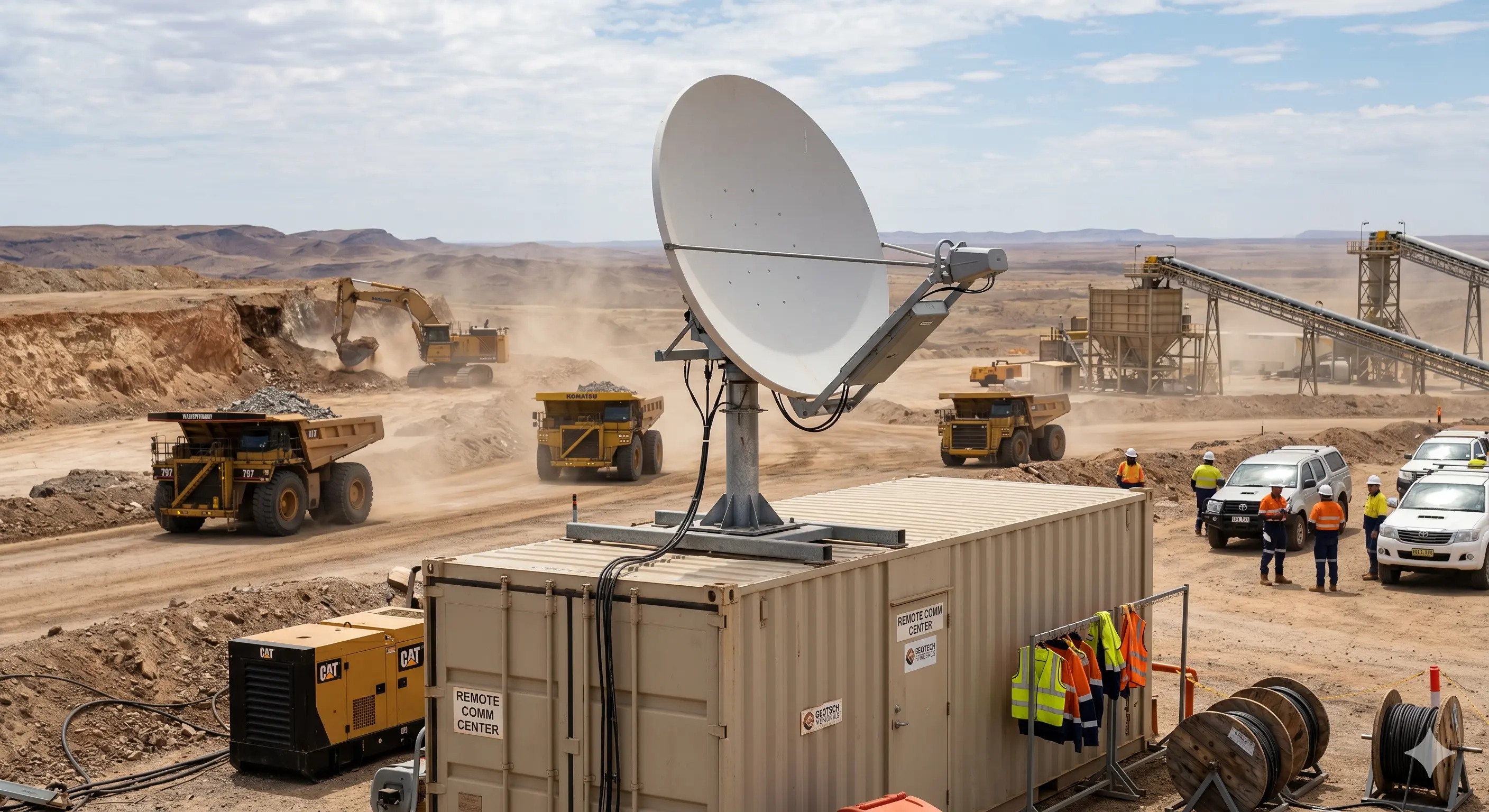
There's a particular kind of frustration that anyone who has worked at a remote mine site knows intimately: you're 400 kilometres from the nearest town, your LTE signal is somewhere between "one bar" and "wishful thinking," and the operations centre back in the city needs a status update right now. The ore body isn't moving. Neither is the deadline. But the data? That's stuck.
Reliable connectivity at remote mining operations isn't a nice-to-have. It hasn't been for a long time. Today it underpins everything from real-time equipment telemetry and autonomous vehicle management to crew welfare apps and environmental compliance reporting. And for sites in Central Africa, the Sahara, the Arabian Peninsula, or the remote highlands of Central Asia, the only realistic answer to the connectivity question is satellite — specifically, VSAT (Very Small Aperture Terminal) technology.
This article walks through the real connectivity challenges facing mining operations, how Ka-band and Ku-band VSAT actually solve them, what operational efficiency gains look like in practice, and how GCCSAT approaches satellite connectivity for the extractive industries sector.
The Real Connectivity Challenge at Remote Mine Sites
Most discussions about mining connectivity start with bandwidth numbers. We'll get there. But the more instructive starting point is understanding what "remote" actually means in the mining context — and why terrestrial solutions so consistently fall short.
Mining operations by definition go where the minerals are. The minerals, unsurprisingly, are rarely located near fibre infrastructure or cellular towers. A copper mine in the Democratic Republic of Congo, an iron ore operation in Mauritania, a potash project in Ethiopia, a phosphate mine in Saudi Arabia's interior — these are not places where an ISP is going to run a fibre backhaul anytime soon.
The connectivity challenges that matter most at these sites include:
- Physical isolation: Sites are often 200–800 km from the nearest city with meaningful infrastructure. Microwave links become impractical beyond about 60–80 km without relay towers, each of which needs power and maintenance.
- Terrain interference: Mountains, valleys, and dense vegetation break line-of-sight for terrestrial wireless. Even flat desert terrain doesn't help much when you need to cover hundreds of kilometres.
- Power constraints: Communications infrastructure at remote sites needs to run reliably on generator or solar power with minimal intervention.
- Harsh environments: Dust, extreme heat, heavy rainfall, and vibration from blasting and heavy equipment all take a toll on electronics.
- Scalability demands: A mine site that starts with 50 workers can grow to 2,000 in a few years. The network has to scale with it.
Then there are the bandwidth demands themselves. An autonomous haul truck system can generate 1–2 TB of data per day. Drone survey platforms push high-resolution imagery that needs to reach the geology team in real time. IP cameras for safety monitoring run continuously. And on top of all of that, 1,500 workers all want to video-call home on Sunday evening.
Ka-Band vs Ku-Band VSAT: Choosing the Right Frequency for Your Mine
Not all VSAT is the same. The frequency band you operate in has significant implications for performance, availability, and cost — particularly in the environments where mines tend to be located.
Ku-Band VSAT (11–14 GHz)
Ku-band has been the workhorse of mining connectivity for two decades. It's widely available across Africa, MENA, and Europe, with mature satellite coverage and a large installed base of compatible hardware. Typical throughput on a dedicated Ku-band link runs from 2 Mbps to 20+ Mbps downlink depending on terminal size and contention ratios.
The key advantage of Ku-band in mining contexts is its relative resilience to rain fade. At Ku frequencies, heavy rain does attenuate the signal — but not as severely as at Ka frequencies, making it more reliable in high-rainfall environments like Central and West Africa. Terminal sizes are typically in the 0.9m to 1.8m dish range, which is entirely manageable on a mine site.
Ka-Band VSAT (26.5–40 GHz)
Ka-band satellites carry significantly more capacity than older Ku-band birds, which translates to lower cost per megabit and higher available throughputs. Modern Ka-band High Throughput Satellite (HTS) systems can deliver 50 Mbps, 100 Mbps, or more to a single site using relatively compact 0.75m to 1.2m antennas.
The trade-off is rain fade sensitivity. Ka-band signals are more significantly affected by heavy precipitation, which matters in tropical mining regions. This is mitigated through Adaptive Coding and Modulation (ACM) — the system automatically adjusts modulation and coding rates during rain events to maintain the link at reduced throughput rather than dropping it entirely. Proper link budget planning and fade margin engineering handles this in most cases.
For mines in arid regions — which describes much of MENA and the Saharan belt — Ka-band is often the better choice economically. For sites in equatorial Africa or other high-rainfall zones, Ku-band or a hybrid approach may be preferable.
C-Band VSAT (3.7–4.2 GHz)
C-band remains relevant for some mining applications, particularly in regions with extreme weather or where very high link availability (99.9%+) is contractually required. C-band is the most resilient to rain fade of the three, but requires larger antennas (2.4m to 3.7m), making deployment more complex. It's worth considering for critical SCADA and safety systems where even a brief outage is unacceptable.
What VSAT Actually Enables at a Mine Site
Let's move from theory to practice. Here's what reliable satellite connectivity actually unlocks for a mining operation.
Real-Time Equipment Telemetry and Fleet Management
Modern mining fleets generate enormous amounts of data. CAT MineStar, Komatsu DISPATCH, Wenco, and similar fleet management platforms depend on continuous two-way data flow between machines and the operations centre. Fuel consumption, engine diagnostics, payload data, cycle times, queue lengths at the crusher — all of this flows over the network continuously.
With a properly designed VSAT link delivering 10–50 Mbps of reliable throughput, mine operators can run these systems without compromise. The latency on a geostationary VSAT link — typically 550–650 ms round-trip — is entirely acceptable for fleet management telemetry, which doesn't require real-time control responses.
Autonomous and Remote-Controlled Equipment
This is where connectivity requirements get more demanding. Autonomous haul trucks from Komatsu, CAT, and Sandvik operate within defined zones and communicate with each other and the control system continuously. While the vehicles themselves make decisions locally, the management layer needs reliable connectivity.
Remote-controlled equipment — drill rigs operated from a control room kilometres away, for example — does require lower latency. This is one area where integrating a LEO satellite component (Starlink or OneWeb) alongside VSAT makes sense, as LEO latency of 20–40 ms is dramatically better than GEO latency for control applications. We'll cover hybrid approaches in another article in this series.
Drone Surveys and High-Resolution Imagery Transfer
Drone-based photogrammetry and LiDAR surveys have become standard at progressive mine sites. A single drone survey flight can produce 10–50 GB of raw imagery. Getting that data to the geology and survey team — who may be based in another country — requires real bandwidth.
With a dedicated Ka-band VSAT link at 50 Mbps, a 20 GB survey dataset transfers in about 53 minutes. That's the difference between having processed results available for the afternoon shift planning meeting versus waiting until tomorrow.
Safety and Compliance Systems
Mine sites run extensive IP camera networks for safety monitoring. Environmental sensors track dust, noise, and vibration. Blast monitoring systems record seismic activity. All of this data needs to flow reliably to operations centres and potentially to regulatory authorities.
VSAT provides the always-on, symmetric connectivity these systems need. Unlike cellular where upload speeds are often severely constrained, dedicated VSAT links can provide meaningful symmetric capacity — critical when you're streaming video surveillance footage off-site.
Crew Welfare and Retention
This one doesn't always get the prominence it deserves in technical discussions, but operators know it's commercially significant. Worker retention at remote mine sites is a persistent challenge. Connectivity to family — video calls, streaming, social media — has a measurable impact on employee satisfaction and turnover rates.
A study of Australian fly-in-fly-out mining operations found that reliable internet access was among the top three factors cited by workers when evaluating whether to accept a remote site posting. The same dynamic plays out across Africa and MENA. Providing a properly segmented crew welfare network — separate from operational traffic, with appropriate quality-of-service policies — is an investment that pays back in reduced recruitment and training costs.
Network Architecture: Designing VSAT for a Mine Site
A mine site VSAT deployment isn't just a dish on a roof. Getting it right requires careful network architecture planning.
The typical approach involves a hub-and-spoke architecture where the mine site's VSAT terminal connects to a teleport hub, which provides the gateway to the internet and potentially to private corporate WAN connections. For multi-site mining groups, a shared hub arrangement allows bandwidth pooling across sites — unused capacity at one site can be dynamically allocated to another experiencing peak demand.
On the site LAN side, the VSAT modem connects to a core router (Peplink, Cisco, or similar) that handles traffic prioritisation, firewall functions, and — in modern deployments — SD-WAN policy management. Critical operational traffic (SCADA, fleet management, safety systems) is given priority treatment. Crew welfare traffic is shaped so that a wave of evening video calls doesn't degrade the operations centre connection.
Physical installation considerations include:
- Antenna mounting on a stable, vibration-isolated structure — blast vibrations can knock a dish off-aim if the mount isn't properly engineered
- Lightning protection appropriate to the region
- Radome or pressurisation for extreme dust environments
- Redundant power supply with UPS and generator backup
- Remote monitoring capability so the VSAT system can be diagnosed and often recovered without an on-site technician
Operational Efficiency Gains: What the Numbers Look Like
It's worth putting some concrete numbers around the operational efficiency gains that connectivity enables, because this is where the business case is made.
Consider a mid-sized open-pit copper mine operating 30 haul trucks. Without reliable connectivity, the mine operates its fleet management system on a store-and-forward basis — data syncs when trucks reach certain waypoints, decisions are made with information that's 10–30 minutes old. With real-time fleet management, studies by mining technology companies consistently show productivity improvements of 8–15% from better dispatch decisions alone. On a mine producing 50,000 tonnes per day, that's a significant figure.
Remote condition monitoring of fixed plant equipment — crushers, mills, conveyors — allows predictive maintenance programs that reduce unplanned downtime. Unplanned downtime at a large mine can cost $500,000 to several million dollars per day. Reducing unplanned downtime by even 1–2 days per year more than covers the cost of a VSAT system many times over.
Connectivity also enables remote expert support. Instead of flying a specialist from Perth, London, or Johannesburg to diagnose a problem — which might take 24–48 hours and cost $20,000+ in travel and time — a video call and remote system access can resolve many issues in hours.
GCCSAT Mining Connectivity Solutions
GCCSAT has been deploying satellite connectivity for extractive industry clients across the MENA region and Africa for years. Our VSAT for Mining solutions are designed specifically for the demands of mine site environments — not adapted from maritime or enterprise products, but purpose-built for the dust, heat, vibration, and operational criticality of mining operations.
Our mining connectivity deployments typically include:
- Ka-band or Ku-band VSAT as the primary link, sized to the site's operational data requirements
- C-band backup for critical SCADA and safety systems where link availability requirements exceed what a single Ka or Ku link can guarantee
- Peplink SD-WAN for intelligent traffic management, link bonding, and failover between satellite links and any available LTE
- Managed QoS policies that protect operational traffic while providing crew welfare access
- Remote monitoring and NOC support so issues are detected and addressed before they impact operations
We work with mining clients through the full lifecycle: site survey and link budget analysis, equipment procurement and supply, installation and commissioning, and ongoing managed service. For many clients operating across multiple countries in Africa or the Gulf, we handle the regulatory licensing for satellite operation in each jurisdiction — which is often a significant complexity that operators don't anticipate.
Regulatory and Licensing Considerations in MENA and Africa
This is something that catches many mining operators off guard. Satellite communications are regulated at the national level, and each country in which you operate requires specific licensing for VSAT terminals. In some African nations, the process is straightforward. In others, it can be complex, time-consuming, and subject to local content or partnership requirements.
MENA countries vary significantly. The UAE has a well-defined licensing framework through the TDRA. Saudi Arabia operates through the Communications, Space and Technology Commission (CST). Other Gulf states have their own regulatory bodies with their own requirements.
Getting this right before you start installation avoids costly delays and potential legal exposure. GCCSAT has established relationships with regulators and local partners across our operating regions, which means we can navigate licensing efficiently and get your site connected within the project timeline.
Future-Proofing Your Mining Connectivity Investment
The satellite connectivity landscape is changing faster than at any point in the last two decades. LEO constellations from Starlink and OneWeb are now operational and delivering impressive performance in many regions. The question for mining operators is how to invest now without boxing themselves in as the technology evolves.
The answer, in most cases, is a hybrid-ready architecture. Deploy VSAT as your primary, proven backbone — it's reliable, globally available, and well-understood. But build your network around an SD-WAN platform (Peplink is our preferred choice for mining environments) that can seamlessly integrate LEO satellite links alongside your VSAT connection as that technology matures and gains coverage in your region.
This approach means you're not ripping and replacing. You're adding capability as it becomes available, while maintaining the reliability your operations depend on today.
If you're scoping connectivity for a new mine site, or reassessing an existing deployment that isn't meeting operational needs, talk to the GCCSAT team. We've done this across some genuinely challenging environments — sites in West Africa with extreme rainfall, remote Gulf desert locations with temperature swings of 50°C, high-altitude operations in Central Asia. The problems are familiar. The solutions are proven.
Summary: Why VSAT Remains the Mining Industry Standard
Despite all the excitement around LEO satellites, geostationary VSAT remains the most mature, most widely licensed, and most operationally proven solution for remote mining connectivity. It delivers the reliability and coverage consistency that mining operations require — 24/7, in any weather, in any region.
Ka-band HTS systems now offer price-per-megabit economics that would have been unthinkable five years ago. Ku-band remains the resilient, wide-coverage option for challenging weather environments. C-band provides the ultimate in link availability for the most critical applications. And modern SD-WAN platforms tie it all together with intelligent traffic management.
The mining industry has enough genuine challenges — geology, commodity prices, permitting, logistics. Connectivity shouldn't be one of them.