
Starlink + Peplink SD-WAN: The Complete Enterprise Connectivity Guide
By GCCSAT Editorial Team • April 29, 2026 • 8 min read
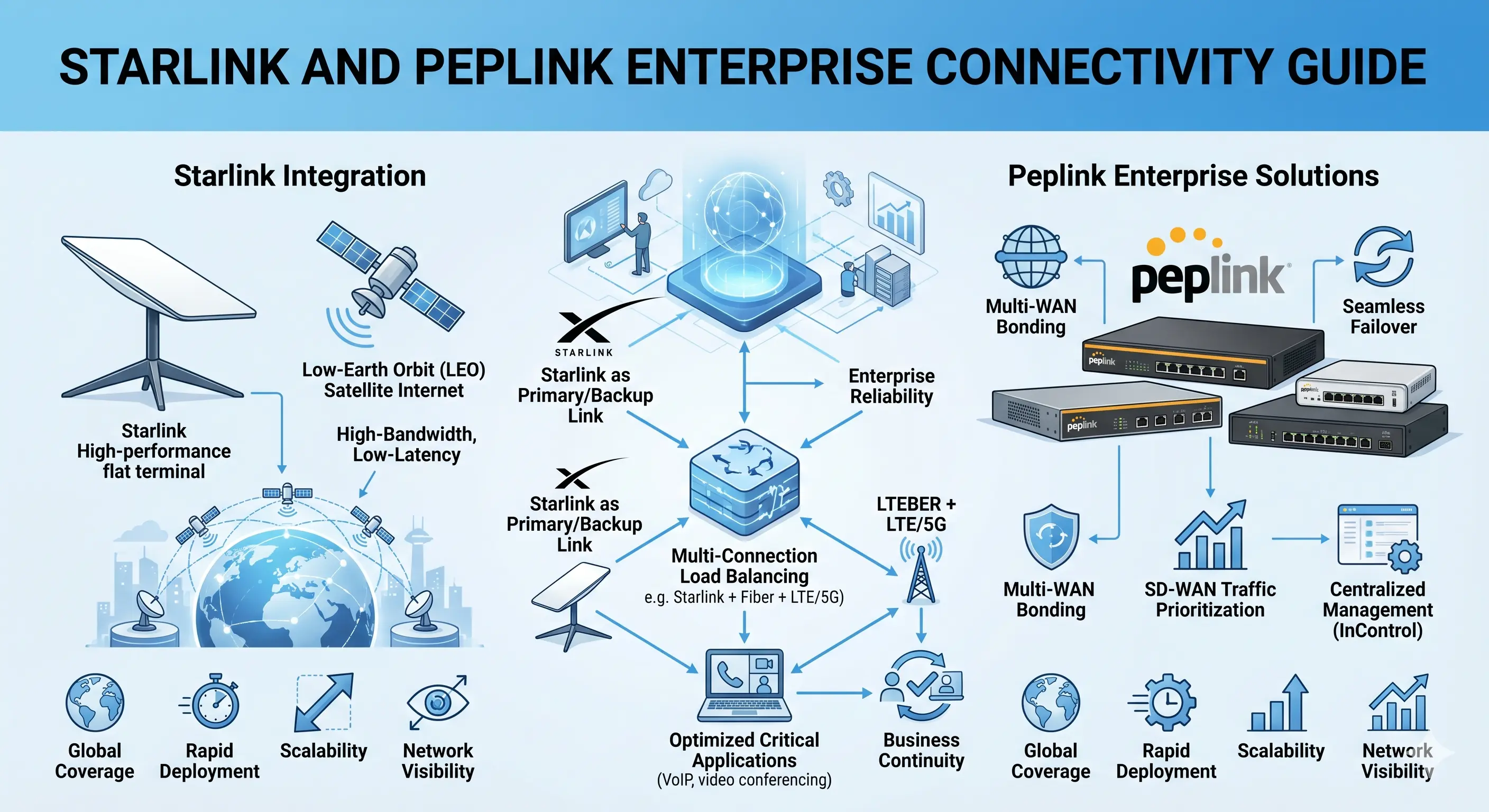
A few years ago, the idea of running a stable enterprise network over Starlink would have prompted polite scepticism from most network engineers. Today, it's not just viable — when paired with the right SD-WAN platform, it's genuinely impressive. The combination of Starlink LEO satellite and Peplink SD-WAN has quietly become one of the most talked-about connectivity architectures in industries that operate where fibre doesn't reach.
But "Starlink plus Peplink" is not a plug-and-play magic solution. The way you design the deployment matters enormously. Get it right and you have a resilient, high-performance network with intelligent failover and true link bonding. Get it wrong and you have an expensive setup that still drops VoIP calls and frustrates your operations team.
This guide is written for the people who actually have to make these networks work — network engineers, IT managers, and operations technology leads in industries like oil and gas, maritime, and remote enterprise. We'll cover the technology fundamentals, the design principles, and the real-world use cases where this combination shines.
Understanding Starlink's Enterprise Positioning
Starlink entered commercial operation with a consumer focus, but SpaceX has increasingly positioned the service for enterprise and mobility applications. The Starlink Business tier and Starlink Maritime service offer priority data access, dedicated support, and higher throughput ceilings than the residential product.
The performance figures are genuinely compelling. In good conditions, a Starlink terminal delivers:
- Download speeds: 100–220 Mbps (typical), with bursts to 300+ Mbps
- Upload speeds: 10–40 Mbps
- Latency: 20–60 ms round-trip (compared to 550–650 ms for geostationary VSAT)
- Latency variability (jitter): Can be 5–25 ms, which matters for real-time applications
The low latency is the headline number, and it's real. For applications that genuinely require it — video conferencing, VoIP, remote desktop, and increasingly remote equipment control — 20–60 ms feels dramatically better than GEO satellite.
The honest caveat is that Starlink's performance in the enterprise context isn't always as consistent as those peak figures suggest. The LEO constellation is still expanding. In some coverage areas, particularly across parts of Africa and the Middle East, capacity is tighter than in mature markets like Europe or North America. Throughput during peak periods can drop significantly on the standard service tier. This is precisely why the SD-WAN layer isn't optional — it's essential.
Why Peplink SD-WAN Is the Right Partner for Starlink
There are several credible SD-WAN platforms on the market. We specify Peplink for most of our enterprise satellite deployments for reasons that go beyond brand preference.
Peplink was built from the ground up for multi-WAN environments. Its core architecture assumes that no single link is perfectly reliable and that the network's job is to work around impairment automatically. This philosophy, baked into the hardware and firmware, makes it particularly well-suited to satellite connectivity where link characteristics can shift quickly.
Key Peplink capabilities that matter for Starlink deployments:
SpeedFusion Bonding and Hot Failover
SpeedFusion is Peplink's proprietary WAN bonding technology. It creates a virtual tunnel that spans multiple physical WAN connections simultaneously, sending data across all active links and reassembling it at the other end. The result is effective bonding of bandwidth — a Starlink link at 100 Mbps plus a VSAT link at 30 Mbps can deliver combined throughput approaching 130 Mbps to the application layer.
More importantly for reliability, SpeedFusion's Hot Failover mode maintains active sessions across a link failure. If Starlink momentarily drops — a satellite handover event, a brief obstruction, a sudden weather change — the session doesn't break. The VSAT or LTE link absorbs the traffic instantly. From the user's perspective: nothing happens. The VoIP call doesn't drop. The VPN session doesn't reset. The SCADA system keeps updating.
WAN Smoothing for Jitter-Sensitive Traffic
Starlink's jitter characteristics can be problematic for UDP-based real-time traffic like VoIP and video conferencing. Peplink's WAN Smoothing feature sends duplicate packets across multiple links simultaneously, taking whichever arrives first. This effectively reduces perceived jitter by 60–80% in most configurations, making real-time communication far more reliable over satellite links than it would otherwise be.
Application-Aware Traffic Steering
Not all traffic should use all links equally. Peplink's outbound policy engine allows you to define sophisticated routing rules: VoIP traffic always goes via the lowest-latency link (Starlink), large file transfers use the highest-throughput link available, SCADA traffic has dedicated priority and failover, crew welfare traffic is rate-limited and policy-controlled. This granularity is what separates a properly engineered network from a "just plug it in" setup.
InControl 2 Cloud Management
For multi-site deployments — an oil company with platforms across three countries, a shipping company managing 20 vessels — Peplink's InControl 2 cloud management platform provides centralised visibility and configuration management. You can see the real-time status of every link at every site, push configuration changes, and generate capacity reports without visiting a single site. In remote operations, this management overhead reduction is commercially significant.
Reference Architecture: Dual-Link Enterprise Deployment
The most common deployment pattern we implement for enterprise clients combines Starlink as the primary high-performance link with VSAT (Ka-band or Ku-band) as the resilient secondary. Here's what the architecture looks like in practice.
At the remote site, a Peplink Balance or MAX router connects to both the Starlink terminal and the VSAT modem on its WAN interfaces. A third WAN interface accommodates an LTE modem where any cellular signal is available — even 1–2 bar of LTE can provide useful additional redundancy for critical traffic.
SpeedFusion tunnels are established to a FusionHub instance running at a cloud data centre or the corporate headquarters. All bonded traffic traverses these encrypted tunnels. This also means all traffic exits the internet at a defined corporate egress point, which satisfies security and compliance requirements that simply doing split-tunnelling over Starlink would not.
Traffic policies in this typical configuration:
- Starlink (primary): Real-time applications (VoIP, video conferencing, remote desktop), interactive user traffic
- VSAT (secondary/bonded): Bulk data transfers, backup and replication, operational data feeds
- LTE (tertiary/emergency): Critical monitoring and SCADA traffic only, highly rate-limited crew access during satellite outages
- SpeedFusion bonding: Applied to all traffic during periods of adequate combined throughput
Oil and Gas Use Case: Offshore Platform Connectivity
Offshore oil and gas platforms represent one of the most demanding connectivity environments on earth. Operations run 24/7. Safety systems cannot fail. Decision-making often involves specialists based thousands of kilometres away. And the platform may be in a location where satellite is the only option.
A typical platform in the North Sea, Persian Gulf, or West African offshore zone might have these requirements:
- SCADA connectivity to shore control room: always-on, high-availability, low-bandwidth but zero tolerance for outages
- Remote expert access for engineering and reservoir teams: video conferencing, large file transfer (seismic data, well logs)
- IP telephony (VOIP) replacing legacy PABX systems
- Crew welfare: typically 50–200 personnel wanting internet access during off-shift hours
- Potentially some IoT/IIoT sensor data aggregation
The Starlink + Peplink combination handles all of this well. SCADA traffic is given absolute priority in Peplink's QoS policies and protected by WAN Smoothing so a momentary Starlink handover event doesn't interrupt it. VoIP runs over Starlink's 20–40 ms latency path, delivering quality comparable to terrestrial telephony. Large data transfers are scheduled during off-peak periods and routed across both links using SpeedFusion bonding. Crew internet is rate-limited per user and time-of-day scheduled so evening peaks don't degrade operational systems.
Critically, the VSAT link — typically a Ku-band or Ka-band GEO satellite — provides a bulletproof fallback. GEO VSAT is mature, well-characterised technology. Its performance doesn't vary with constellation population or orbital geometry. When Starlink has a bad hour, the VSAT link keeps the critical systems running without anyone needing to intervene.
Maritime Use Case: Fishing Fleets and OSVs
Maritime applications for Starlink + Peplink have proliferated quickly, and for good reason. Starlink Maritime covers a large portion of ocean coverage between roughly 70°N and 70°S latitude — which covers the vast majority of active fishing grounds and commercial shipping lanes.
For Offshore Supply Vessels (OSVs) and similar small-to-medium commercial vessels, the economics of Starlink Maritime are attractive compared to traditional VSAT. Monthly costs for Starlink Maritime Business are typically lower than equivalent VSAT bandwidth, and the installation is significantly simpler — the Starlink flat panel antenna requires no pointing and installs quickly.
The challenge is that a single Starlink link on a vessel isn't enterprise-grade. Signal can be intermittently blocked by superstructure as the vessel moves. Handovers between satellites — which happen every few minutes — cause brief microsecond-level disruptions that accumulate into jitter. In high seas, extreme vessel motion can occasionally cause brief outages.
Peplink's marine-specific products — the MAX HD4 MBX and MAX Transit series — are designed for exactly this environment. Paired with a Starlink Maritime terminal and a Ku-band VSAT backup, the system delivers seamless connectivity across all operational conditions. The FusionHub hosted at a shore-based data centre or the company's operations centre aggregates all traffic and provides the enterprise WAN gateway.
For fishing fleets, the operational benefits extend beyond crew welfare. Catch reporting, VMS (Vessel Monitoring System) data, weather routing, and price discovery for catch at landing all benefit from reliable connectivity. Some fishing operators are now using video-based AI systems to assess catch quality and species compliance in real time — a use case that simply wasn't possible without the bandwidth that Starlink provides.
Performance Benchmarks: What to Expect in Practice
Based on our deployed sites across the MENA region, Europe, and Africa, here are realistic performance figures for a properly configured Starlink + Peplink dual-link enterprise deployment:
- Combined throughput (bonded): 120–250 Mbps download, 30–60 Mbps upload
- Effective latency for VoIP (with WAN Smoothing): 25–65 ms, MOS score typically 4.0–4.3
- Failover time on primary link loss: Under 1 second with SpeedFusion Hot Failover
- Session continuity on failover: Active TCP sessions maintained, no reconnection required
- Link availability (dual-link system): Typically 99.85–99.95% depending on location and satellite coverage maturity
These figures are not theoretical maximums — they represent what our NOC team actually observes in production deployments. They will vary based on location, satellite coverage density, terminal hardware, and configuration quality.
Hardware Selection and Sizing
Peplink's product range is broad enough that selecting the right unit requires some analysis. For typical enterprise remote site applications, we commonly deploy:
- Peplink Balance 310X or 380X: For fixed sites with up to 150 concurrent users. Dual 10GbE LAN ports, multi-WAN with dedicated SFP, SpeedFusion included.
- Peplink Balance One Core: Smaller sites or secondary locations, up to 60 concurrent users, cost-effective for budget-conscious deployments.
- Peplink MAX HD4 MBX: Marine and mobile deployments, ruggedised, supports up to 4 WAN connections including cellular modems, purpose-built for vessel use.
- FusionHub Solo or Pro: Cloud-hosted SpeedFusion endpoint, deployed at AWS, Azure, or on-premise data centre. Essential for hub-and-spoke SpeedFusion architectures.
On the Starlink side, the appropriate terminal depends on the deployment context. The Starlink Business flat panel is suitable for most fixed remote sites. The Starlink Maritime terminal with IP67 weatherproofing and enhanced motion tolerance is the right choice for vessels. For permanently mounted installations requiring professional mounting hardware, additional third-party mounting solutions from companies like Intellian or custom fabrication may be appropriate.
Security Considerations in Satellite SD-WAN Deployments
Running enterprise traffic over commercial satellite services introduces security considerations that need to be addressed in the design.
The most important principle: never trust the satellite path. All traffic traversing Starlink or VSAT should be encrypted end-to-end through the SpeedFusion tunnels or independent IPSec/TLS overlays. The satellite link is a transport medium, not a trusted network segment.
Peplink's SpeedFusion uses AES-256 encryption by default, which meets or exceeds the requirements of most enterprise security policies. For government-adjacent applications or particularly sensitive operations, additional encryption layers can be implemented without significant performance penalty given the ample processing power of current Peplink hardware.
Network segmentation at the remote site is equally important. Operational technology (OT) networks — SCADA, PLCs, instrumentation — should be on separate VLANs from IT networks (user computers, servers) and crew welfare networks (personal devices). Peplink's VLAN support and inter-VLAN firewall policies make this segmentation straightforward to implement and manage centrally.
GCCSAT's Starlink and Peplink Solutions
GCCSAT is a certified Peplink partner and an authorised Starlink reseller for enterprise and maritime applications across MENA, Africa, and Europe. Our Starlink and Peplink connectivity solutions cover the full deployment lifecycle: requirements analysis, hardware supply, installation, configuration, and ongoing managed service.
We don't just sell hardware — we design networks. That distinction matters because a misconfigured SD-WAN deployment can actually perform worse than a simple single-link setup. The intelligence in Peplink's platform is only as good as the policies that drive it, and getting those policies right requires experience with the specific traffic patterns and performance requirements of your industry.
If you're evaluating Starlink + Peplink for an oil and gas installation, a vessel fleet, or any remote enterprise environment, get in touch with our team. We can provide a network design and realistic performance expectations based on your specific site locations and traffic requirements.
The Bottom Line
Starlink alone is a better-than-nothing solution for remote connectivity. Starlink with Peplink SD-WAN is a properly engineered enterprise network. The difference in real-world reliability, application performance, and operational continuity is substantial.
For oil and gas operators, maritime companies, and remote enterprises that cannot afford connectivity failures, the combination of LEO satellite speed with intelligent SD-WAN management and GEO satellite backup represents the current best practice in satellite-dependent network design. The technology is proven, the hardware is readily available, and the operational benefits are measurable.
The question isn't whether to do it. It's whether you're doing it right.